457 posters, 2 videos, 2 audios, 8 topics, 45 sessions, 401 authors, 265 institutions
ePostersLive by SciGen Technologies S.A. All rights reserved.
49th Annual Regional Anesthesiology and Acute Pain Medicine Meeting
March 21-23, 2024 | The Hilton Bayfront San Diego | San Diego, California

5647
ATTITUDES TOWARDS AND USAGE OF THE 2017 CANADIAN GUIDELINE FOR OPIOID THERAPY AND CHRONIC NONCANCER PAIN AMONG CANADIAN PHYSICIANS
Poster Presenter
Authors
Affiliations
Part of Topic
Scientific Abstracts > Chronic Pain
TITLE:
Attitudes towards, and usage of, the 2017 Canadian Guideline for opioid therapy and chronic non-cancer pain among Canadian physicians
AUTHORS:
Grahanya Sachidanandan1, Jane Jomy1, Natasha Kithulegoda2, Jason Busse3
1 Temerty Faculty of Medicine, University of Toronto, Toronto, Ont.; 2 Women's College Institute for Health Systems Solutions and Virtual Care, Women’s College Hospital, Toronto, Ont.; 3 The Michael G. DeGroote Institute for Pain Research and Care, Department of Anesthesia, Department of Health Research Methods, Evidence, and Impact, McMaster University, Hamilton, Ont
INTRODUCTION:
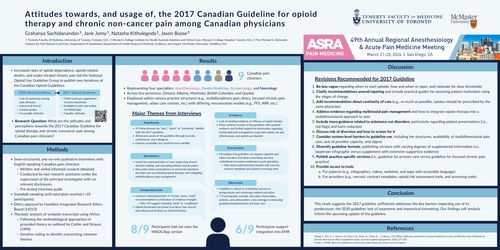
Increased rates of opioid dependence, opioid-related deaths, and under-treated chronic pain led the National Opioid Use Guideline Group to publish two iterations of the Canadian Opioid Guidelines
Research Question: What are the attitudes and perceptions towards the 2017 Canadian Guideline for opioid therapy and chronic noncancer pain among Canadian pain clinicians?
METHODS:
Semi-structured, one-on-one qualitative interviews with English-speaking Canadian pain clinicians
- Written and verbal informed consent obtained
- Conducted by two research assistants under the supervision of the principal investigator with no relevant disclosures
- Pre-tested interview guide
Snowball sampling until saturation reached (~10 participants)
Ethics approval by Hamilton Integrated Research Ethics Board (14313)
Thematic analysis of verbatim transcripts using NVivo
- Following the methodological approaches of grounded theory as outlined by Corbin and Strauss (1990)
- Iterative coding to identify overarching common themes
RESULTS:
9 Canadian pain clinicians
Representing four specialties: Anesthesiology, Family Medicine, Gynaecology, and Neurology
Across five provinces: Ontario, Alberta, Manitoba, British Columbia, and Quebec
Employed within various practice structures (e.g., multidisciplinary pain clinics, focused chronic pain management, urban care centres, etc.) with differing remuneration models (e.g., FFS, ARP, etc.)
Major Themes from Interviews
Familiary: 9/9 interviewees are “very”, “quite”, or “extremely” familiar with the 2017 guideline; All became aware of the guideline through journals, conferences, and colleagues; Formats accessible, but could be more variable
Usefulness: Useful for standardization of care, supporting shared decision making, and educating patients and providers; Not useful when contradictory to provincial standards, providers are not initiating opiate therapy, and navigating multidisciplinary pain management
Comprehension: Common misinterpretation of “strong” versus “weak” recommendations as indicators of evidence strength; Only 3/9 suggest renaming “weak” to “conditional”; Opioid thresholds perceived to produce fear around prescribing and as limits on clinical freedom
Evidence: Lack of existing evidence on efficacy of opiate therapy; Many endorse revision of the guideline with updated evidence and further supportive information regarding multimodal pain management, long-term opiate use and effectiveness, and opioid use disorder
Practicality: Perception that guideline can impose cognitive and labour burdens that deter prescribing and thus redistribute increased workloads to pain specialists; May reduce administrative burden with narcotic contract templates and patient/screening tools
Education: Guideline is valued as a teaching resource in postgraduate and continuing medical education; 7/9 participants consider education of providers, patients, and policymakers a key strategy to improving guideline implementation and pain care
8/9 Participants had not seen the MAGICApp version
6/9 Participants support integration into EMR
DISCUSSION:
Revisions Recommended for 2017 Guideline
1. Be less vague regarding when to start opioids, how and when to taper, and rationale for dose thresholds
2. Clarify recommendations around tapering and include practical guides for assessing patient motivation using the stages of change
3. Add recommendation about continuity of care (e.g., as much as possible, opiates should be prescribed by the same physician)
4. Address evidence regarding multimodal pain management and how to integrate opiate therapy into a multidimensional approach to pain
5. Include more guidance related to substance use disorders, particularly regarding patient presentations (i.e., red flags) and harm reduction
6. Discuss risk of diversion and how to screen for it
7. Consider system-level barriers to guideline use, including fee structures, availability of multidimensional pain care, lack of provider capacity, and stigma
8. Diversify guideline formats, publishing versions with varying degrees of supplemental information (i.e., layperson infographic versus supplement with extensive supportive evidence)
9. Publish practice-specific versions (i.e., guideline for primary care versus guideline for focused chronic pain practice)
10. Provide access to tools
a. For patients (e.g., infographics, videos, websites, and apps with accessible language)
b. For providers (e.g., narcotic contract templates, opioid risk assessment tools, and screening tools)
CONCLUSION:
This study suggests the 2017 guideline sufficiently addresses the key barriers impacting use of its predecessor, the 2010 guideline: lack of awareness and impractical formatting. Our findings will similarly inform the upcoming update of the guideline.
REFERENCES:
Chang, Y., Zhu, K. L., Florez, I. D., Cho, S. M., Zamir, N., Toma, A., ... & Busse, J. W. (2016). Attitudes toward the Canadian Guideline for Safe and Effective Use of Opioids for Chronic Non-Cancer Pain: A qualitative study. Journal of opioid management, 12(6), 377-387.
Corbin, J. (1990). Basics of qualitative research grounded theory procedures and techniques.