457 posters, 2 videos, 2 audios, 8 topics, 45 sessions, 401 authors, 265 institutions
ePostersLive by SciGen Technologies S.A. All rights reserved.
49th Annual Regional Anesthesiology and Acute Pain Medicine Meeting
March 21-23, 2024 | The Hilton Bayfront San Diego | San Diego, California

5241
UNVEILING UNMET PAIN AND PALLIATIVE CARE NEEDS AMONG CANCER PATIENTS IN RURAL NORTH INDIA: A PARTICIPATORY ACTION APPROACH
Poster Presenter
Authors
Affiliations
Part of Topic
Scientific Abstracts > Chronic Pain
Video
Audio
Unveiling unmet Pain and palliative care needs among cancer patients in Rural North India: A Participatory Action Approach
Background:
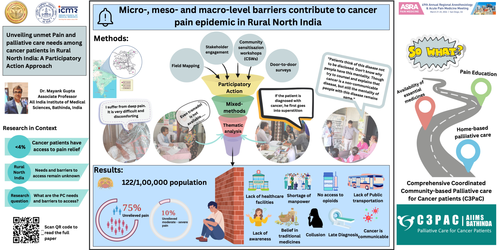
Less than 4% of cancer patients in India have access to pain relief. Existing palliative care (PC) facilities are restricted to tertiary hospitals in urban areas with limited accessibility to those living in rural North India. For palliative care services to be context-specific, it is important to identify the local needs and barriers to implementation. These needs and barriers remain largely unknown in rural north India.
Objective:
The aim of this research was to assess unmet pain and PC needs and barriers to accessing PC among cancer patients.
Methods:
The study was conducted in one of the rural blocks in Punjab, North India. The study block consists of 6 sectors with 27 sub-centers, 1 Community Health Center and 66 villages. Its rural location, high cancer burden, ease of accessibility, and positive rapport with the various stakeholders led to its selection as the study area.
A participatory action research (PAR) approach was employed where cancer patients, their caregivers, community health workers, medical officers, village sarpanch and local nongovernmental organisations contributed as participants. These participants were selected based on convenient and purposive sampling. The PAR cycles included defining the problem, action, observation and reflection. Situational assessment, community sensitisation workshops (CSWs) and door-to-door surveys were planned, conducted and further developed over three PAR cycles.
The CSW sessions (in 27 subcentres) were audio recorded, transcribed verbatim and back-translated. The data was coded, and thematic analysis was done. The data was triangulated with filed notes and supported by quotations from the transcripts.
A sub-centre-wise door-to-door survey of all the households aimed to identify cancer patients and their palliative care needs was conducted. The tools (SPICT-4ALL and ESAS) allowed the assessment of PC requirements in regard to the general and disease-specific indicators and the prevalence and intensity of pain and other symptoms among cancer patients.
Results:
A total of 242 cancer patients were identified and assessed for demographic profile, disease characteristics and symptom burden. The most common cancer sites were breast, gastrointestinal, gynaecological, haematological and head and neck.
Seventy-six per cent of community-dwelling cancer patients had pain, with 9.9% having moderate-severe pain.
Physical pain emerged as one of the major contributors to suffering, impacting every aspect of patients’ and their caregivers’ lives. The thematic analysis revealed various macro- (lack of healthcare facilities, manpower, essential medicines and public transportation), meso- (cultural beliefs in traditional medicines) and micro-(lack of awareness, collusion, myths related to cancer and opioids) barriers to accessing pain relief.
Implications:
Our findings provide a roadmap for developing targeted services to establish context-specific comprehensive, coordinated community-based palliative care for cancer patients (C3PaC). The next stage of our project will focus on improving accessibility to PC services by addressing the identified gaps through the adoption of the WHO public health model for palliative care development.