457 posters, 2 videos, 2 audios, 8 topics, 45 sessions, 401 authors, 265 institutions
ePostersLive by SciGen Technologies S.A. All rights reserved.
49th Annual Regional Anesthesiology and Acute Pain Medicine Meeting
March 21-23, 2024 | The Hilton Bayfront San Diego | San Diego, California

5494
PERCUTANEOUS PNS REDUCES CHRONIC POSTOPERATIVE PAIN AND IMPROVES FUNCTION AFTER TKA: RESULTS FROM A PLACEBO-CONTROLLED RCT
Poster Presenter
Authors
Affiliations
Part of Topic
Scientific Abstracts > Chronic Pain
Percutaneous PNS Reduces Chronic Postoperative Pain and Improves
Function after TKA: Results from a Placebo-Controlled RCT
Stuart A Grant, MD,1 JH Goree, MD,2 DM Dickerson, MD,3,4 BM Ilfeld, MD,5 Y Eshraghi, MD,6 S Vaid, MD,7 AK Valimahomed, MD,8 JR Shah, MD,2 GL Smith, MD,2 JJ Finneran, MD,5 NN Shah,
MD,3,4 MN Guirguis, MD,6 MS Eckmann, MD,9 AB Antony, MD,10 BJ Ohlendorf, MD,11 M Gupta, MD,12 JE Gilbert, PhD,13 A Wongsarnpigoon, PhD,13 JW Boggs, PhD13
• Significant pain relief compared to placebo (sham) stimulation during treatment.
• Increased walking ability compared to placebo (sham) stimulation, which may be beneficial for
encouraging activity and improving functional recovery
• Improved function compared to placebo (sham) stimulation, including stiffness and physical
function.
Funding:
Support for this study was provided by the Department of Defense (DoD; The Office of the Assistant Secretary of Defense for Health Affairs,
through the Peer Reviewed Orthopaedic Research Program under Award No. W81XWH1810799) and by SPR Therapeutics. Opinions,
interpretations, conclusions and recommendations are those of the authors and are not necessarily endorsed by the DoD.
Key Eligibility Criteria:
• Subjects with persistent moderate to severe postoperative pain
following knee replacement (BPI-SF Q#5 ≥5) and stable for 2 weeks.
• Stable medication usage for ≥ 4-weeks prior to baseline visit and
current opioid-use ≤90 mg morphine equivalent dose (MED).
• No conditions contraindicated by PNS system’s instructions for use.
• Age ≥21 years
• BMI ≤ 40 kg/m2
• No diagnosis of diabetes.
• Knee arthroplasty, including total knee arthroplasty (TKA), is an effective surgical
procedure, and approximately 800,000 procedures are performed in the United
States each year.
• ~10-20% of patients continue to experience persistent postoperative pain (i.e., pain
>3 months after surgery or past the time of normal tissue healing).
• Postoperative pain may lead to functional limitations and poor quality of life [1].
Study Goal: Characterize responses to 60-day percutaneous PNS
in a post-market, institutional review board (IRB)-approved,
prospectively registered (NCT04341948), multicenter, double-blind,
placebo-controlled, randomized trial.
• IRB-approved study; informed consent obtained from each subject.
• Participants were randomized 1:1 to 60-day PNS or Placebo
(Sham) with subjects and a designated evaluator blinded to group
assignments.
• Present poster shows data through primary endpoint (End of
Treatment; EOT). Long-term follow up/crossover phase is ongoing.
Treatment:
Active or placebo (sham) stimulation for 24 hours/day for up
to 60 days using a wearable stimulator and percutaneous
coiled lead.
Lead Placement: Percutaneous PNS leads placed under
ultrasound guidance remotely targeting the femoral and sciatic
nerves proximal to the region of postoperative pain [2-4].
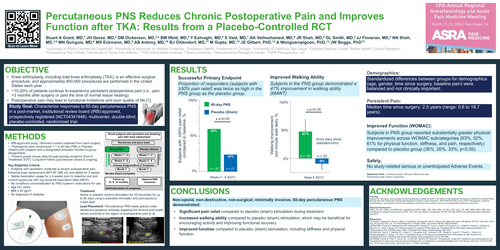
Successful Primary Endpoint
Subjects with ≥50% pain relief
compared to baseline, %
Weeks 5 - 8 (EOT)
References:
[1] Wylde V, Beswick A, Bruce J, Blom A, Howells N, Gooberman-Hill R. Chronic pain after total knee arthroplasty. EFORT Open Rev. 2018
Aug 16;3(8):461-470. doi: 10.1302/2058-5241.3.180004. PMID: 30237904; PMCID: PMC6134884.
[2] Ilfeld BM, Plunkett A, Vijjeswarapu AM, Hackworth R, Dhanjal S, Turan A, Cohen SP, Eisenach JC, Griffith S, Hanling S, Sessler DI,
Mascha EJ, Yang D, Boggs JW, Wongsarnpigoon A, Gelfand H Percutaneous, Peripheral Nerve Stimulation (Neuromodulation) for
Postoperative Pain: A Randomized, Sham-controlled Pilot Study, Anesthesiology, April 2021.
[3] Ilfeld B.M., Ball S.T., Gabriel R.A., Sztain J.F., Monahan A.M., Abramson W.B., Khatibi B., Said E.T., Parekh J., Grant S.A.,
Wongsarnpigoon A., Boggs J.W. 2018. A Feasibility Study of Percutaneous Peripheral Nerve Stimulation for the Treatment of
Postoperative Pain Following Total Knee Arthroplasty. Neuromodulation; 22 (5), 653-660.
[4] Albright-Trainer B, Phan T, Trainer RJ, Crosby ND, Murphy DP, Disalvo P, Amendola M, Lester DD. Peripheral nerve stimulation for the
management of acute and subacute post-amputation pain: a randomized, controlled feasibility trial. Pain Manag. 2022 Apr;12(3):357-369.
doi: 10.2217/pmt-2021-0087. Epub 2021 Nov 11. PMID: 34761694.
Relevant Disclosures:
DMD, YE, AKV, NNS, and MNG are consultants for SPR. DMD, JHG, SAG, BMI, SV, AKV, JRS, GLS, JJF, NNS, MNG, MSE, ABA, BJO,
and MG have research sponsored by SPR. JEG, AW, and JWB are employees of SPR. AW and JWB have ownership/options interests
with SPR.
60-day PNS
Placebo (Sham)
Proportion of responders (subjects with
≥50% pain relief) was twice as high in the
PNS group as the placebo group.
60%
n = 21
100%
50%
0%
* p<0.05
Improved Walking Ability
Subjects in the PNS group demonstrated a
47% improvement in walking ability
(6MWT).
Week 8 (EOT)
Walking improvement
(six-minute walk test), %
100%
50%
0%
n = 18 n = 20
Error bars show
standard error
Statistical Tests: Continuous data: Wilcoxon Rank Sum test
Proportional data: Fisher’s exact test
n = 20
24%
47%
-9%
Subjects in PNS group reported substantially greater physical
improvements across WOMAC subcategories (63%, 52%,
61% for physical function, stiffness, and pain, respectively)
compared to placebo group (36%, 26%, 33%; p<0.05).
Improved Function (WOMAC):
No study-related serious or unanticipated Adverse Events.
Safety:
Median time since surgery: 2.5 years (range: 0.6 to 18.7
years).
Persistent Pain:
Standardized differences between groups for demographics
(age, gender, time since surgery, baseline pain) were
balanced and not clinically important.
Demographics:
* p<0.05
1University of North Carolina at Chapel Hill, 2University of Arkansas for Medical Sciences, 3Endeavor Health, 4University of Chicago, 5University of California San Diego, 6Ochsner Medical