457 posters, 2 videos, 2 audios, 8 topics, 45 sessions, 401 authors, 265 institutions
ePostersLive by SciGen Technologies S.A. All rights reserved.
49th Annual Regional Anesthesiology and Acute Pain Medicine Meeting
March 21-23, 2024 | The Hilton Bayfront San Diego | San Diego, California

5611
AN ANALYSIS ON THE CORRELATION OF SOCIAL DETERMINANTS OF HEALTH WITH REPORTED PAIN SCORES USING THE ALL OF US RESEARCH PROGRAM
Poster Presenter
Authors
Affiliations
Part of Topic
Scientific Abstracts > Chronic Pain
Introduction
- Social determinants of health (SDoH) are non-medical
factors related to a person’s specific conditions related to how
they were born, grow, work, live and age and are feature that
influence health outcomes.1
- Examples of SDoH include a persons’ own experience with
income and social protection, education, employment,
working life conditions, food insecurity, housing, stress
levels, childhood development, social support, and access to
care.
- Inter-individual perception of pain is an important
characteristic that may contribute to the expectations and
outcomes of patients.
- It is unclear how a persons’ own SDoH measures are related to
pain outcomes.
- OBJECTIVE: To understand better how these various
components of SDoH may be correlated with reported pain
Methods:
- This was a retrospective observational study, in which all
patients with available survey data related to SDoH were
analyzed from the All of Us Research Program database.2
- Survey results related to SDoH were provided from ~500,000
patients. This survey elicited numerous questions related to
patient-specific experiences with various SDoH components. In
addition, patients reported their average pain score experienced
daily over the last 7 days (based on the Numeric Rating Scale
[NRS]).
- Responses were provided on a Likert scale (1 – 5), binary
responses (yes or no), numeric scale (1-15), or categorical.
- To measure association of each question using Likert scale
with pain scores, the Spearman’s rank correlation co. efficient
was calculated. To measure association of each question not
using Likert scale, linear regression was performed, and the Rsquared
metric was reported. A P-value <0.001 was considered
statistically significant and a correlation value ≥0.2 was
considered clinically significant.
- Multivariable analysis controlled for age, sex, BMI, chronic
pain, and opioid use disorder
Results:
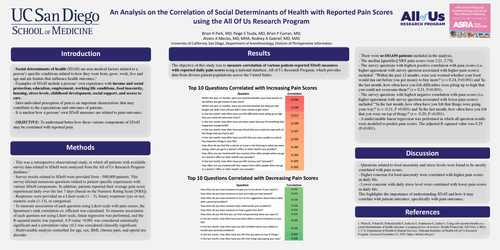
- There were n=183,650 patients included in the analysis.
- The median [quartiles] NRS pain scores were 2 [1, 2.75].
- The survey questions with highest positive correlation with
pain scores (i.e. higher agreement with survey question
associated with higher pain scores) included: ‘'Within the past
12 months, were you worried whether your food would run out
before you got money to buy more?' (r = 0.24, P<0.001) and 'In
the last month, how often have you felt difficulties were piling
up so high that you could not overcome them?' (r = 0.21,
P<0.001).
- The survey questions with highest negative correlation with
pain scores (i.e. higher agreement with survey question
associated with lower pain scores) included “'In the last month,
how often have you felt that things were going your way?' (r = -
0.21, P <0.001) and 'In the last month, how often have you felt
that you were on top of things?' (r = -0.20, P <0.001).
- A multivariable linear regression was performed in which all
question results were modeled to predict pain scores. The
adjusted R-squared value was 0.25 (P<0.001).
Discussion:
- Questions related to food insecurity and stress levels were
found to be mostly correlated with pain scores.
- Higher concerns for food insecurity were correlated with
higher pain scores in daily life.
- Lower concerns with daily stress level were correlated with
lower pain scores in daily life.
This highlights the importance of understanding SDoH and
how it may correlate with patient outcomes, specifically with
pain outcomes.