457 posters, 2 videos, 2 audios, 8 topics, 45 sessions, 401 authors, 265 institutions
ePostersLive by SciGen Technologies S.A. All rights reserved.
49th Annual Regional Anesthesiology and Acute Pain Medicine Meeting
March 21-23, 2024 | The Hilton Bayfront San Diego | San Diego, California

5409
SERIAL STELLATE GANGLION BLOCKS AMELIORATE ANOSMIA AND DYSGEUSIA FROM LONG COVID: A CASE REPORT
Poster Presenter
Authors
Part of Topic
Scientific Abstracts > Chronic Pain
Serial Stellate Ganglion Blocks Ameliorate Anosmia and Dysgeusia from Long COVID
David Yim MD, Dalmar Mohamod DO*, Nwadi Igwe MD, Kanchana Gattu MBBS, Seung Lee MD, Thelma Wright MD
Dept of Anesthesiology, University of Maryland, Baltimore
Introduction:
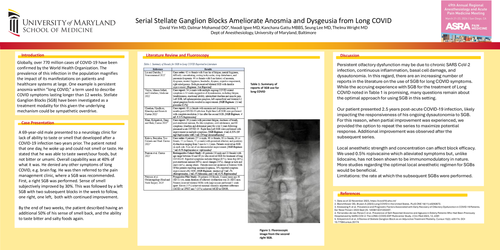
Globally, over 770 million cases of COVID-19 have been confirmed by the World Health Organization. The prevalence of this infection in the population magnifies the impact of its manifestations on patients and healthcare systems at large. One example is persistent anosmia within “long COVID,” a term used to describe COVID symptoms lasting longer than 12 weeks. Stellate Ganglion Blocks (SGB) have been investigated as a treatment modality for this given the underlying mechanism could be sympathetic overdrive.
Case Presentation:
A 69-year-old male presented to a neurology clinic for lack of ability to taste or smell that developed after a COVID-19 infection two years prior. The patient noted that one day, he woke up and could not smell or taste. He stated that he was able to taste sweet/sour foods, but not bitter or umami. Overall capability was at 40% of what it was. He denied any other symptoms of long COVID, e.g. brain fog. He was then referred to the pain management clinic, where a SGB was recommended. First, a right SGB was performed. Sense of smell subjectively improved by 30%. This was followed by a left SGB with two subsequent blocks in the week to follow, one right, one left, both with continued improvement.
By the end of two weeks, the patient described having an additional 50% of his sense of smell back, and the ability to taste bitter and salty foods again.
Discussion:
Persistent olfactory dysfunction may be due to chronic SARS CoV-2 infection, continuous inflammation, basal cell damage, and dysautonomia. In this regard, there are an increasing number of reports in the literature on the use of SGB for long COVID symptoms. While the accruing experience with SGB for the treatment of Long COVID noted in Table 1 is promising, many questions remain about the optimal approach for using SGB in this setting.
Our patient presented 2.5 years post-acute COVID-19 infection, likely impacting the responsiveness of his ongoing dysautonomia to SGB. For this reason, when partial improvement was experienced, we provided the option to repeat the series to maximize potential response. Additional improvement was observed after the subsequent series.
Local anesthetic strength and concentration can affect block efficacy. We used 0.5% ropivacaine which alleviated symptoms but, unlike lidocaine, has not been shown to be immunomodulatory in nature. More studies regarding the optimal local anesthetic regimen for SGBs would be beneficial.
Limitations: the rate at which the subsequent SGBs were performed.