457 posters, 2 videos, 2 audios, 8 topics, 45 sessions, 401 authors, 265 institutions
ePostersLive by SciGen Technologies S.A. All rights reserved.
49th Annual Regional Anesthesiology and Acute Pain Medicine Meeting
March 21-23, 2024 | The Hilton Bayfront San Diego | San Diego, California

5146
EFFECTIVENESS OF CHEMICAL NEUROLYSIS FOR TREATMENT OF KNEE PAIN: A SYSTEMATIC REVIEW OF THE CURRENT LITERATURE
Poster Presenter
Part of Topic
Scientific Abstracts > Chronic Pain
Effectiveness of Chemical Neurolysis for Treatment of Knee Pain: A Systematic Review of the Current Literature
Authors: Vladislav Zhitny, M.D., Kenny Do, B.S., Eric Kawana, B.S., Adlai Pappy, M.D., Shengping Zou, M.D., Michael C. Wajda, M.D., Jenifer Do, Ryan Gualtier, M.D., Joseph Manne, M.D., Benjamin Klyachman, D.O., Benjamin Vachirakorntong, B.S., Adam Khattak, D.O., Aditi Singh, M.D., Mohammed Issa, M.D.
INTRO:
METHODS
RESULTS
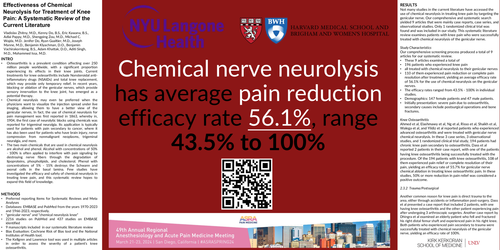
Not many studies in the current literature have accessed the use of chemical neurolysis in treating knee pain by targeting the genicular nerve. Our comprehensive and systematic search yielded 9 articles that were mainly case reports, case series, and observational studies. Only 1 randomized clinical trial was found and was included in our study. This systematic literature review examines patients with knee pain who were successfully treated with chemical neurolysis of the genicular nerve.
Study Characteristics
Our comprehensive screening process produced a total of 9 articles for our systematic review.
Knee Osteoarthritis
Ahmed et al, Elashmawy et al, Ng et al, Risso et al, Shaikh et al, Walega et al, and Yildiz et al reported patients who experienced advanced osteoarthritis and were treated with genicular nerve chemical neurolysis. In these 3 case series, 3 observational studies, and 1 randomized clinical trial study, 194 patients had chronic knee pain secondary to osteoarthritis. Dass et al reported 2 patients in their case report, with one of the patients having knee osteoarthritis being successfully treated with the procedure. Of the 194 patients with knee osteoarthritis, 108 of them experienced pain relief or complete resolution of their pain, yielding an efficacy rate of 55.7% for genicular nerve chemical ablation in treating knee osteoarthritic pain. In these studies, 50% or more reduction in pain relief was considered a positive outcome.
2.3.2 Trauma/Postsurgical
Another common reason for knee pain is direct trauma to the area, either through accidents or inflammation post-surgery. Dass et al presented a case report that included 2 patients, with one having knee osteoarthritis and the other patient experiencing pain after undergoing 3 arthroscopic surgeries. Another case report by Dhingra et al examined an elderly patient who fell and fractured his right distal femur shaft and experienced pain in his right knee. Both patients who experienced pain secondary to trauma were successfully treated with chemical neurolysis of the genicular nerve, yielding an efficacy rate of 100%.