457 posters, 2 videos, 2 audios, 8 topics, 45 sessions, 401 authors, 265 institutions
ePostersLive by SciGen Technologies S.A. All rights reserved.
49th Annual Regional Anesthesiology and Acute Pain Medicine Meeting
March 21-23, 2024 | The Hilton Bayfront San Diego | San Diego, California

5285
PATIENT CHARACTERISTICS AND EVALUATED CRITERIA ASSOCIATED WITH COMPLEX REGIONAL PAIN SYNDROME: A RETROSPECTIVE INSTITUTIONAL STUDY
Poster Presenter
Authors
Affiliations
Part of Topic
Scientific Abstracts > Chronic Pain
Audio
Introduction
Complex Regional Pain Syndrome (CRPS) is a rare, but debilitating neuropathic pain condition with an estimated prevalence of up to 1.2% in the general population.1 CRPS typically affects a specific region of the body and can present itself in a multitude of ways, with common symptoms being discoloration, swelling, and hypersensitivity of the affected area. The condition is associated with dysfunction of or injury to the peripheral nervous system and may emerge following obvious limb trauma and subsequent nerve damage. While there is often a distinct inciting event, CRPS may also be attributed to long-term overuse or have no obvious cause. A formal diagnosis in a clinical setting falls into one of two categories: type I, which features no obvious or identifiable nerve damage, and type II, which is characterized by a detectable nerve injury. Variation amongst symptomatic presentation has made the standard objective assessment of CRPS difficult, resulting in inconsistent diagnoses and treatment decisions. There is a developing consensus amongst medical professionals on standardizing a formal CRPS diagnosis, with the “Budapest Criteria” increasingly becoming the accepted diagnostic tool.2 In an effort to better understand how providers at a high-volume urban institution focused on musculoskeletal health diagnose and treat patients with CRPS, we created an automated analytical registry within the electronic health record, Epic, to capture new patient encounters with qualifying diagnoses, including CRPS.3 A retrospective chart review of the CRPS registry patients was then manually conducted to investigate demographic and clinical characteristics of CRPS patients.
Material and Methods
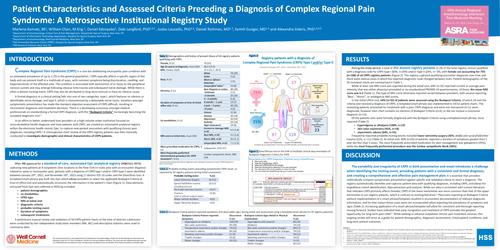
After IRB approval for a standard-of-care, automated Epic analytical registry (IRB#2021-0076) capturing new patients at 8 outpatient clinic locations in the New York tri-state area with an encounter diagnosis related to spine or neuropathic pain, patients with a diagnosis of CRPS type I and/or CRPS type II were identified between January 20th, 2022, and November 28th, 2023 using 17 distinct ICD-10 codes and the SlicerDicer tool. A template/smart phrase was built into Epic which allows providers to select the applicable Budapest Criteria at time of office visit and automatically structures the information in the patient’s chart (Figure 1). Data elements extracted from Epic and collected in REDCap included patient demographics, co-morbidities, CRPS type, NRS at initial visit, diagnostic criteria, probable inciting event, duration of symptoms and subsequent treatments. A preliminary manual review and validation of 50 CRPS patient charts at the time of abstract submission were conducted by two independent study team members (MK, WC) and descriptive statistics were used to summarize data.
Results
During the study period, a total of 251 distinct registry patients (1.3% of the total registry census) qualified with a diagnosis code for CRPS type I (83%, n=209) and/or type II (24%, n= 59), with female sex accounting for 75% (n=188) of all CRPS registry patients (Figure 2). The registry captured qualifying encounter diagnoses over time and there were several cases in which the reported diagnostic code changed between visits. Patient demographics of the 50 reviewed charts are summarized in Table 1. While at least one NRS score was reported during the initial visit, 64% (n=32) reported current or average pain intensity that was either physician-prompted or via standardized PROMIS-10 questionnaires; of these, the mean NRS score was 6.3 (Table 1). The type of NRS score otherwise reported varied between providers, with several reporting “Best”, “Worst”, or amibiguous NRS scores. In the initial office visit, 64% (n=32) of patients were assessed using the Budapest Criteria, of which 29 met the criteria and received a diagnosis of CRPS; a template/smart phrase was implemented in 19/32 patient charts. The remaining patients presented for treatment with a prior CRPS diagnosis and were not reassessed (n=1); were diagnosed, however their chart contains no mention of Budapest Criteria (n=4); or did not receive a conclusive diagnosis (n=13). Of the patients who were formally diagnosed with the Budapest Criteria using a template/smart phrase, most reported hyperalgesia or allodynia (100%, n=19), skin color asymmetry (95%, n=18), and asymmetric edema (84%, n=16) (Table 2). Frequently reported probable inciting events included lower extremity surgery (42%, n=21) and sprain/fall/other trauma (22%, n =11) (Table 3). At initial visit, 40% (n=20) of patients reported a duration of symptoms greater than 1 year but less than 5 years. The most frequently prescribed medication for pain management was gabapentin (35%), while the most frequently performed procedure was the lumbar sympathetic block (38%).
Discussion
The variability and irregularity of CRPS in both presentation and onset introduces a challenge when identifying the inciting event, providing patients with a consistent and formal diagnosis, and creating a comprehensive and effective pain management plan. It is essential that providers methodically compare symptomatic presentation against specific and validated criteria to reach a diagnosis. The registry systematically identifies and captures patient data with qualifying diagnoses, including CRPS, and allows for expeditious cohort identification, data extraction and analyses. While our data is consistent with current literature that indicates CRPS primarily affects females, CRPS of the lower extremities was more common than that of the upper extremities in our registry patients, which is contrary to existing literature.4 Consistently evaluating against standard diagnostic criteria and reporting diagnostic details are essential steps in creating patient care plans that are conducive to collaboration among medical professionals. Out of the 32 patients explicitly assessed against the Budapest Criteria, 59% (n=19) of the patient charts contained a clear breakdown of symptoms and signs via an embedded template or smart phrase logic. Physicians reporting on Budapest Criteria without implementation of a smart phrase/template resulted in inconsistent documentation of relevant diagnostic information, and for that reason those cases were not incorporated when reporting the prevalence of symptoms and signs (Table 2). Increasing application of a smart phrase/template will allow for consistent and thorough reporting moving forward. Studies have indicated that early recognition and treatment of CRPS provides the greatest opportunity for long-term pain relief.5 While seeking to advance outpatient chronic pain treatment services, this ongoing review will serve as a guide for patient demographics, diagnostic assessments, initial patient conditions, and long-term patient outcomes.
References
- Murphy KR, Han JL, Yang S, Hussaini SM, Elsamadicy AA, Parente B, Xie J, Pagadala P, Lad SP. Prevalence of Specific Types of Pain Diagnoses in a Sample of United States Adults. Pain Physician. 2017 Feb;20(2):E257-E268. PMID: 28158163.
- Harden NR, Bruehl S, Perez RSGM, Birklein F, Marinus J, Maihofner C, Lubenow T, Buvanendran A, Mackey S, Graciosa J, Mogilevski M, Ramsden C, Chont M, Vatine JJ. Validation of proposed diagnostic criteria (the "Budapest Criteria") for Complex Regional Pain Syndrome. Pain. 2010 Aug;150(2):268-274. doi: 10.1016/j.pain.2010.04.030. Epub 2010 May 20. PMID: 20493633; PMCID: PMC2914601.
- Sideris A, Lauzadis J, Antao V, et al. EP151 Development of an automated chronic pain registry capturing outpatient treatments and patient- reported outcomes. Regional Anesthesia & Pain Medicine 2023;48:A121
- de Mos M, de Bruijn AG, Huygen FJ, Dieleman JP, Stricker BH, Sturkenboom MC. The incidence of complex regional pain syndrome: a population-based study. Pain. 2007 May;129(1-2):12-20. doi: 10.1016/j.pain.2006.09.008. Epub 2006 Nov 7. PMID: 17084977.
- Winston P. Early Treatment of Acute Complex Regional Pain Syndrome after Fracture or Injury with Prednisone: Why Is There a Failure to Treat? A Case Series. Pain Res Manag. 2016;2016:7019196. doi: 10.1155/2016/7019196. Epub 2016 Apr 30. PMID: 27445622; PMCID: PMC4904610.