457 posters, 2 videos, 2 audios, 8 topics, 45 sessions, 401 authors, 265 institutions
ePostersLive by SciGen Technologies S.A. All rights reserved.
49th Annual Regional Anesthesiology and Acute Pain Medicine Meeting
March 21-23, 2024 | The Hilton Bayfront San Diego | San Diego, California

5247
ACUTE AND CHRONIC PAIN OUTCOMES IN BREAST CANCER PATIENTS AFTER TOTAL MASTECTOMY
Poster Presenter
Authors
Affiliations
Part of Topic
Scientific Abstracts > Chronic Pain
A Retrospective Evaluation of the Utility of Preoperative Nerve Pain Medications Prior to Mastectomy in Breast Cancer Patients
INTRO
•Postmastectomy pain syndrome (PMPS) is a chronic neuropathic pain disorder frequently occurring after breast cancer surgery which is estimated to affect 20 to 50% of patients who undergo mastectomy 1
•Several different groups of medications including antiepileptics (pregabalin/gabapentin) and SNRIs (venlafaxine/duloxetine) have been effective in treating patients with mastectomy associated neuropathic pain 2
•The objective of this study is a retrospective comparison of acute and chronic postoperative outcomes after total mastectomy between patients who were premedicated prior to surgery with nerve pain medications such as gabapentin, pregabalin, duloxetine compared to those started on the same medications postoperatively for neuropathic pain.
•
METHODS
•Propensity score matched case-control study using TriNetX - a federated open-source database housing de-identified patient data
•Selected patients with diagnosis of primary breast cancer status post complete mastectomy to one or both breasts with or without axillary lymph node dissection.
•Compared Outcomes for patients premedicated with duloxetine, gabapentin, or pregabalin within a 3-month preoperative window compared to patient’s started on the same medications within the first month postoperatively.
•We standardized for preoperative opioid use, with inclusion criteria for both cohorts including patients on less than 20 morphine milliequivalents (MME) of opioid therapy.
•Cohorts were matched with respect to age at diagnosis, African American ethnicity, diabetes mellitus, preoperative diagnosis of diabetic peripheral neuropathy or mononeuropathy, obesity, depression, anxiety, preoperative diagnosis of chronic pain, chemotherapy treatment, radiation treatment, and the use of perioperative lidocaine.
•Primary outcomes investigated included the incidence of acute postoperative pain, acute postoperative nausea or vomiting, surgical site infection, development of chronic regional pain syndrome (CRPS), chronic post mastectomy pain, referred mastectomy pain, and post-mastectomy lymphedema syndrome (PMLES).
•
RESULTS
•Cohorts: 1530 patients each; Mean age approximately 57 years
•Reduction in acute postoperative pain in premedicated cohort (Gross: 266, 224; 17.4% versus 14.6%, p = 0.038). With a risk ratio of 1.188 [95% CI: (1.009,1.398).
•Reduction in post-mastectomy lymphedema syndrome in premedicated cohort(Gross: 80,53; 5.2% versus 3.5%, p = 0.017). With a risk ratio of 1.509 [95% CI: (1.075,2.120).
•Other outcomes which were evaluated included surgical site infection rate, CRPS, post-op nausea/vomiting, chronic PMPS, and referred pain all of which yielded no statistically significant differences between the cohorts
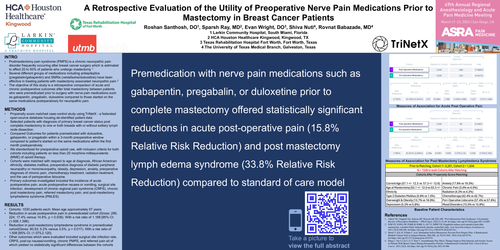
Premedication with nerve pain medications such as gabapentin, pregabalin, or duloxetine prior to complete mastectomy offered statistically significant reductions in acute post-operative pain (15.8% Relative Risk Reduction) and post mastectomy lymph edema syndrome (33.8% Relative Risk Reduction) compared to standard of care model