457 posters, 2 videos, 2 audios, 8 topics, 45 sessions, 401 authors, 265 institutions
ePostersLive by SciGen Technologies S.A. All rights reserved.
49th Annual Regional Anesthesiology and Acute Pain Medicine Meeting
March 21-23, 2024 | The Hilton Bayfront San Diego | San Diego, California

5275
RETROSPECTIVE REVIEW OF PUDENDAL NEURALGIA TREATED WITH PULSED RADIOFREQUENCY ABLATIONS
Poster Presenter
Authors
Part of Topic
Scientific Abstracts > Chronic Pain
Retrospective Review of Pudendal Neuralgia Treated With Pulsed Radiofrequency Ablations
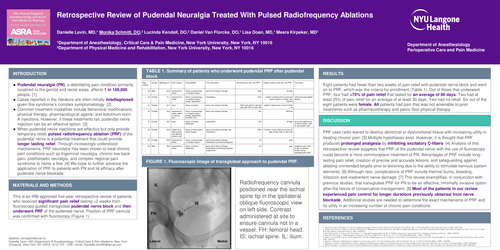
This is an IRB-approved five-year retrospective review of patients who received significant pain relief lasting <2 weeks from fluoroscopy-guided transgluteal pudendal nerve block and then underwent PRF of the pudendal nerve. Position of PRF cannula was confirmed with fluoroscopy (Figure 1).
Radiofrequency cannula positioned near the ischial spine tip in the ipsilateral oblique fluoroscopic view on left side. Contrast administered at site to ensure cannula not in a vessel. FH: femoral head. IS: ischial spine. IL: ilium.
Eight patients had fewer than two weeks of pain relief with pudendal nerve block and went on to PRF, which was the criteria for enrollment (Table 1). Out of those that underwent PRF, four had >75% of pain relief that lasted for an average of 80 days. Two had at least 25% of pain relief for an average of at least 30 days. Two had no relief. Six out of the eight patients were female. All patients had pain that was not amenable to prior treatments such as pharmacotherapy and pelvic floor physical therapy.
PRF uses radio waves to destroy abnormal or dysfunctional tissue with increasing utility in treating chronic pain. [5] Multiple hypotheses exist. However, it is thought that PRF produces prolonged analgesia by inhibiting excitatory C-fibers. [4] Analysis of this retrospective review suggests that PRF of the pudendal nerve with the use of fluoroscopy could become a more commonplace treatment of PN. Advantages of PRF include long-lasting pain relief, creation of precise and accurate lesions, and safeguarding against ablating unintended targets prior to lesioning due to the ability to stimulate nervous system elements. [6] Although rare, complications of PRF include thermal burns, bleeding, infection, and inadvertent nerve damage. [7] This review exemplifies, in conjunction with previous studies, that transgluteal PRF for PN to be an effective, minimally invasive option after the failure of conservative management. [8] Most of the patients in our review experienced pain control for longer durations previously obtained from nerve blockade. Additional studies are needed to determine the exact mechanisms of PRF and its utility in an increasing number of chronic pain conditions.