457 posters, 2 videos, 2 audios, 8 topics, 45 sessions, 401 authors, 265 institutions
ePostersLive by SciGen Technologies S.A. All rights reserved.
49th Annual Regional Anesthesiology and Acute Pain Medicine Meeting
March 21-23, 2024 | The Hilton Bayfront San Diego | San Diego, California

5242
PERIOPERATIVE GASTRIC ULTRASOUND FINDINGS IN GLP-1 AGONIST USERS AT VARIOUS TIME POINTS: A CASE SERIES
Poster Presenter
Authors
Affiliations
Part of Topic
Scientific Abstracts > Case Series
Perioperative Gastric Ultrasound in GLP-1 agonist Users at Various Time Points: A Case Series Conclusion
Steve Kwon, MD, Pamela Chia, MD
Department of Anesthesiology & Perioperative Medicine, David Geffen School of Medicine, UCLA
Introduction
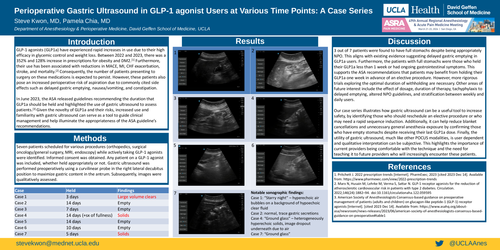
GLP-1 agonists (GLP1a) have experienced rapid increases in use due to their high efficacy in glycemic control and weight loss. Between 2022 and 2023, there was a 352% and 128% increase in prescriptions for obesity and DM2.[1] Furthermore, their use has been associated with reductions in MACE, MI, CHF exacerbation, stroke, and mortality.[2] Consequently, the number of patients presenting to surgery on these medications is expected to persist. However, these patients also pose an increased perioperative risk of aspiration due to commonly cited side effects such as delayed gastric emptying, nausea/vomiting, and constipation.
In June 2023, the ASA released guidelines recommending the duration that GLP1a should be held and highlighted the use of gastric ultrasound to assess patients.[3] Given the novelty of GLP1a and their risks, increased use and familiarity with gastric ultrasound can serve as a tool to guide clinical management and help illuminate the appropriateness of the ASA guideline’s recommendations.
Methods
Seven patients scheduled for various procedures (orthopedics, surgical oncology/general surgery, MRI, endoscopy) while actively taking GLP-1 agonists were identified. Informed consent was obtained. Any patient on a GLP-1 agonist was included, whether held appropriately or not. Gastric ultrasound was performed preoperatively using a curvilinear probe in the right lateral decubitus position to maximize gastric content in the antrum. Subsequently, images were qualitatively assessed.
Discussion
3 out of 7 patients were found to have full stomachs despite being appropriately NPO. This aligns with existing evidence suggesting delayed gastric emptying in GLP1a users. Furthermore, the patients with full stomachs were those who held their GLP1a less than 1 week or had ongoing gastrointestinal symptoms. This supports the ASA recommendations that patients may benefit from holding their GLP1a one week in advance of an elective procedure. However, more rigorous trials exploring the optimal duration of withholding are necessary. Other areas of future interest include the effect of dosage, duration of therapy, tachyphylaxis to delayed emptying, altered NPO guidelines, and stratification between weekly and daily users.
Our case series illustrates how gastric ultrasound can be a useful tool to increase safety, by identifying those who should reschedule an elective procedure or who may need a rapid sequence induction. Additionally, it can help reduce blanket cancellations and unnecessary general anesthesia exposure by confirming those who have empty stomachs despite receiving their last GLP1a dose. Finally, the utility of gastric ultrasound, much like other POCUS modalities, is user dependent and qualitative interpretation can be subjective. This highlights the importance of current providers being comfortable with the technique and the need for teaching it to future providers who will increasingly encounter these patients.
References
1. Pritchett J. 2022 prescription trends [Internet]. PharmExec; 2023 [cited 2023 Dec 14]. Available from: https://www.pharmexec.com/view/2022-prescription-trends
2. Marx N, Husain M, Lehrke M, Verma S, Sattar N. GLP-1 receptor agonists for the reduction of atherosclerotic cardiovascular risk in patients with type 2 diabetes. Circulation. 2022;146(24):1882–94. doi:10.1161/circulationaha.122.059595
3. American Society of Anesthesiologists Consensus-based guidance on preoperative management of patients (adults and children) on glucagon-like peptide-1 (GLP-1) receptor agonists [Internet]. [cited 2023 Dec 14]. Available from: https://www.asahq.org/about- asa/newsroom/news-releases/2023/06/american-society-of-anesthesiologists-consensus-based- guidance-on-preoperative#table1