457 posters, 2 videos, 2 audios, 8 topics, 45 sessions, 401 authors, 265 institutions
ePostersLive by SciGen Technologies S.A. All rights reserved.
49th Annual Regional Anesthesiology and Acute Pain Medicine Meeting
March 21-23, 2024 | The Hilton Bayfront San Diego | San Diego, California

5181
CONTINUOUS PERICAPSULAR NERVE GROUP BLOCK (PENG) FOR PAIN MANAGEMENT IN HIP FRACTURES, A CASE SERIES
Poster Presenter
Authors
Affiliations
Part of Topic
Scientific Abstracts > Case Series
Pericapsular nerve group (PENG) block is a recently described ultrasound-guided technique that is used as an analgesic block for acute pain management after hip fracture, with subsequent studies expanding the original indication. This block targets the articular branches of the femoral, obturator, and accessory obturator nerves, which innervate the anterior hip capsule. A catheter inserted in the plane between the iliopsoas muscle and iliopubic eminence can extend the analgesic duration. In this report, we describe the technique of PENG catheter placement and its application in five patients presenting with various hip fractures. Pain scores were determined by Numeric Rating Scale (NRS) prior to catheter placement and during maintenance phases.
Case 1: 67 year old female presented for right hemiarthroplasty due to a pathologic fracture of right femur neck from metastatic breast cancer. Her surgery was not scheduled until few days after admission for further medical optimization, and her pain was poorly controlled with oral and intravenous medications. Initial NRS was 10/10. NRS decreased to 1/10 at rest and 2/10 with movement 20 minutes after PENG catheter placement. The Catheter was maintained for 4 days and removed on the day of surgery. Patient’s NRS was maintained at 2/10 at rest and 3/10 with activity until surgery.
Case 2: 64 years old female presented with newly diagnosed small cell lung cancer metastatic to the brain and bones. Our team was consulted for severe left hip pain that was uncontrolled with multimodal pain management including Hydromorphone PCA and Fentanyl patch. Imaging revealed acute displaced and mildly comminuted subcapital pathologic fracture of the left femur as well as large lytic lesions involving the posterior and superolateral left acetabulum. Orthopedic surgery did not have operative plans for the patient until chemotherapy and radiotherapy started. Initial NRS was 10/10. After PENG catheter placement, NRS decreased to 2/10 at rest and was maintained at 2-4/10 until catheter removal on day 7.
Case 3: 43 years old female presented as an outpatient with metastatic right breast cancer and avascular necrosis of right hip for severe right hip pain. Prior imaging revealed an acutely displaced pathologic subcapital fracture of the right femoral neck as well as focal areas of osteoblastic metastasis in the right acetabulum, right ischium and right greater trochanter. Orthopedic team did not recommend a surgical intervention at the time. Initial NRS was 7/10 at rest and 9/10 on movement. Patient received a PENG peripheral nerve catheter which was maintained for 7 days after placement with NRS maintained at 3-4/10.
Case 4: 68 years old female presented for severe pain from a left acetabulum fracture after falling. Orthopedic team recommended non-operative management. Initial NRS was 10/10. NRS decreased from 9/10 to 3-4/10 both at rest and activity after PENG catheter placement. Catheter removed on day 6 prior to discharge.
Case 5: 70 years old female with left breast cancer presented with a displaced subcapital fracture of left proximal femur and lytic lesion in the left femoral diaphysis. Orthopedic team did not recommend a surgical intervention at the time. Initial NRS was 7/10 at rest and 9/10 on movement. Patient received a peripheral nerve catheter that is currently in place and planning to remove on day 7 after placement. NRS decreased to 3/10. Catheter removed on day 6.
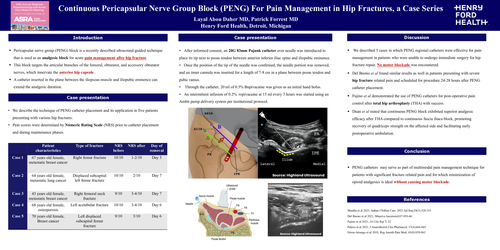
For the five described cases, our regional anesthesia service was consulted and opted to place a PENG catheter for continuous infusion. After informed consent, a 20G 83mm Pajunk catheter over needle was introduced to place its tip next to psoas tendon between anterior inferior iliac spine and iliopubic eminence. Once the position of the tip of the needle was confirmed, the needle portion was removed, and an inner cannula was inserted for a length of 7-8 cm in a plane between psoas tendon and pubic ramus. Through the catheter, 20 ml of 0.5% Bupivacaine was given as an initial hand bolus. An intermittent infusion of 0.2% Ropivacaine at 15 ml every 3 hours was started using an Ambit pump delivery system per institutional protocol.
We described 5 cases in which PENG regional catheters were effective for pain management in patients who were unable to undergo immediate surgery for hip fracture repair. This may serve as part of multimodal pain management technique for patients with significant fracture related pain and for which minimization of opioid analgesics is ideal. In all the aformentioned cases, PENG regional catheters did not cause motor blockade. Del Buono et al found similar results as well in patients presenting with severe hip fracture related pain and scheduled for procedure 24-28 hours after PENG catheter placement. Furthermore, Fujino et al demonstrated the use of PENG catheters for post-operative pain control after total hip arthroplasty (THA) with success. Moreover, Duan et al stated that continuous PENG block exhibited superior analgesic efficacy after THA compared to continuous fascia iliaca block, promoting recovery of quadriceps strength on the affected side and facilitating early postoperative ambulation. In conclusion, the use of a local anesthetic infusion through PENG catheter can serve as an effective pain management strategy in the perioperative pain management of patients with severe pain from hip fractures.