457 posters, 2 videos, 2 audios, 8 topics, 45 sessions, 401 authors, 265 institutions
ePostersLive by SciGen Technologies S.A. All rights reserved.
49th Annual Regional Anesthesiology and Acute Pain Medicine Meeting
March 21-23, 2024 | The Hilton Bayfront San Diego | San Diego, California

5535
THE FEASIBILITY OF PERCUTANEOUS PERIPHERAL NERVE STIMULATORS FOR MANAGEMENT OF PERSISTENT POSTOPERATIVE PAIN
Poster Presenter
Authors
Affiliations
Part of Topic
Scientific Abstracts > Case Series
The Feasibility of Percutaneous Peripheral Nerve Stimulators for Management of Persistent Postoperative Pain
Introduction:
Neurostimulation has been used for a long time as an analgesic modality for a wide variety of pain conditions with evidence of benefit. Technological limits, the invasiveness of lead placement, and cost of the procedure has significantly restricted its use. Recent developments in percutaneous peripheral nerve stimulation (pPNS) technology have allowed for the minimally invasive placement of percutaneous peripheral nerve stimulator leads under ultrasound guidance in a similar manner to continuous peripheral nerve catheters.1 Like similar devices, pPNS provides electric stimulus to nerves to modulate peripheral and central pain responses. Unlike other devices currently in use, these leads are temporary, with therapy lasting only 60 days before lead removal.
A multimodal analgesic strategy, including the use of opioid analgesics, non-steroidal anti-inflammatories, acetaminophen, gabapentinoids, and regional anesthesia, can prove effective for chronic pain when used in an appropriate combination and dosage. However, opioid medications, most notably, have well-known detrimental side effects, risking dependance and potential addiction for patients. Research investigating pPNS as an alternative therapy has grown over the last decade. Several case series and proof-of-concept studies have been completed recently investigating the benefit of pPNS in the perioperative setting for a variety of surgical cases.1 These studies have shown positive results with regards to pain reduction, opioid consumption, and functionality after total knee replacement, foot surgery, rotator cuff repair, and ACL reconstruction. Additionally, recent studies demonstrated the benefit of pPNS for a variety of perioperative and chronic pain pathologies to reduce pain levels and opioid use.2
While the current literature has focused on pPNS placement for either perioperative or chronic pain patients, there exists a population of pain patients who straddle those two groups. The incidence of persistent postoperative pain (generally greater than 6 months post operatively) appears to range from five to 85 percent, depending on the surgery, with the median incidence being 20-30 percent.3 pPNS treatment could provide an alternative option for patients with persistent postoperative pain whose only other options are continued ineffective traditional treatment methods or further surgeries to try to help ameliorate their pain. The goal of this feasibility study is to examine whether the patients with persistent postoperative pain who received pPNS placement from our Regional Anesthesia and Acute Pain Medicine (RAAPM) team achieved notable improvements in pain levels, and if so, were the reductions found comparable to those seen in the existing pPNS-related literature.
Material and Methods:
We received Penn State University IRB approval (STUDY00024034), to retrospectively examine the effects pPNS placement had on qualifying patients’ self-reported pain levels, subjective functionality assessments (e.g. increased ability to perform ADLs, increased exercise tolerance, etc.), and use of prescribed pain medication (if applicable). A total of nine patients have received percutaneous peripheral nerve stimulator lead placement due to ongoing persistent pain that began after a surgical procedure. For the pPNS procedure, each patient was alert and able to give feedback about the sensation elicited and location of the sensation when the pPNS was placed to ensure this was reproduced in their areas of pain. Each lead was placed by a RAAPM team attending anesthesiologist. Prior to the pPNS procedure, informed consent was obtained from patients to use their de-identified information and data for scientific publications and presentations. Patients were contacted weekly by representatives from SPR Technologies to assess patient reported pain scores, pain medication use, and for any troubleshooting that was necessary. The patients then returned to the clinic to have pPNS removed after 60 days.
Results:
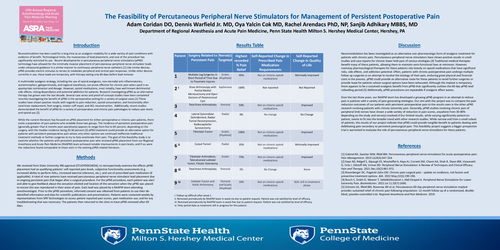
Results table included below.
Discussion:
Neuromodulation has been investigated as an alternative non-pharmacologic form of analgesic treatment for patients with chronic pain. Percutaneous peripheral nerve stimulators have shown positive results in small studies and case reports for chronic lower limb pain of various etiologies.4 Traditional medical therapies benefit many of these patients, allowing them to maintain semi-functional lives at minimum. However, mainstay pharmacological therapies for these patients rely heavily on opioid medications that have significant risks, side effects, and addiction potential. Often, patients with chronic postoperative pain undergo multiple follow up surgeries in an attempt to resolve the etiology of their pain, enduring great physical and financial costs in the process. pPNS could provide an alternative route for these patients to avoid further surgeries or provide hope for patients whose surgical options have been exhausted. Although the implant is temporary, there appears to be a sustained analgesic benefit from pPNS that significantly outlives the 60-day pPNS lead indwelling period.5 Additionally, pPNS procedures are repeatable if analgesic effect wanes.
Over the last three years, our RAAPM team has developed a growing pPNS program in an attempt to reduce pain in patients with a variety of pain generating etiologies. Our aim with this project was to compare the pain reduction outcomes of our patients with persistent postoperative pain to the results seen in the other pPNS research involving patients with chronic extremity pain. Generally, pPNS studies involving chronic pain of peripheral limb nerves have shown a wide variety of reduction in pain scores, anywhere from 30-80% depending on the study and nerve(s) involved.4 Our limited results, while varying significantly patient-to-patient, seems to fit into the broader trend with other research studies. While narrow and from a small subset of patients, the results of our project indicate that pPNS could provide tangible benefit to patients dealing with debilitating pain secondary to persistent postsurgical pain. This feasibility project suggests a bigger prospective trial is warranted to evaluate the role of percutaneous peripheral nerve stimulators for these patients.
References:
[1] Gabriel RA, Swisher MW, Ilfeld BM. Percutaneous peripheral nerve stimulation for acute postoperative pain. Pain Management. 2019 Jul;9(4):347-354.
[2] Kaye AD, Ridgell S, Alpaugh ES, Mouhaffel A, Kaye AJ, Cornett EM, Chami AA, Shah R, Dixon BM, Viswanath O, Urits I, Edinoff AN, Urman RD. Peripheral Nerve Stimulation: A Review of Techniques and Clinical Efficacy. Pain and Therapy. 2021 Dec;10(2):961-972.
[3] Rosenberger DC, Pogatzki-Zahn EM. Chronic post-surgical pain - update on incidence, risk factors and preventive treatment options. BJA Education. 2022 May;22(5):190-196.
[4] Busch C, Smith O, Weaver T, Vallabh J, Abd-Elsayed A. Peripheral Nerve Stimulation for Lower Extremity Pain. Biomedicines. 2022 Jul 11;10(7):1666.
[5] Gilmore CA, Ilfeld BM, Rosenow JM et al. Percutaneous 60-day peripheral nerve stimulation implant provides sustained relief of chronic pain following amputation: 12-month follow-up of a randomized, double-blind, placebo-controlled trial. Regional Anesthesia and Pain Medicine. 2019.