457 posters, 2 videos, 2 audios, 8 topics, 45 sessions, 401 authors, 265 institutions
ePostersLive by SciGen Technologies S.A. All rights reserved.
49th Annual Regional Anesthesiology and Acute Pain Medicine Meeting
March 21-23, 2024 | The Hilton Bayfront San Diego | San Diego, California

5289
EFFICACY OF KETAMINE INFUSION AS A VIABLE OPIOID ALTERNATIVE FOR PAIN CONTROL IN POSTOPERATIVE POPULATIONS
Poster Presenter
Authors
Affiliations
Part of Topic
Scientific Abstracts > Acute Pain
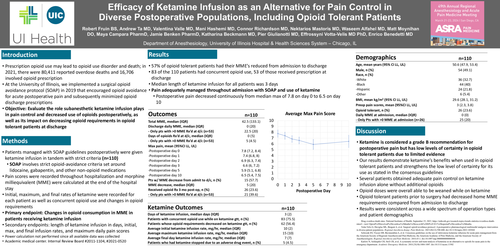
Efficacy of Ketamine Infusion as an Alternative for Pain Control in Diverse Postoperative Populations, Including Opioid Tolerant Patients
Introduction
•Prescription opioid use may lead to opioid use disorder and death; in 2021, there were 80,411 reported overdose deaths and 16,706 involved opioid prescription
•At the University of Illinois, we implemented a surgical opioid avoidance protocol (SOAP) in 2019 that encouraged opioid avoidance for acute postoperative pain and subsequently minimized opioid discharge prescriptions
•Objective: Evaluate the role subanesthetic ketamine infusion plays in pain control and decreased use of opioids postoperatively, as well as its impact on decreasing opioid requirements in opioid tolerant patients at discharge
Methods
•Patients managed with SOAP guidelines postoperatively were given ketamine infusion in tandem with strict criteria (n=110)
•SOAP involves strict opioid-avoidance criteria set around lidocaine, gabapentin, and other non-opioid medications
•Pain scores were recorded throughout hospitalization and morphine milliequivalent (MME) were calculated at the end of the hospital stay
•Initial, maximum, and final rates of ketamine were recorded for each patient as well as concurrent opioid use and changes in opioid requirements
•Primary endpoint: Changes in opioid consumption in MME in patients receiving ketamine infusion
•Secondary endpoints: length of ketamine infusion in days, initial, max, and final infusion rates, and maximum daily pain scores
•Power calculation not performed since all available data was collected
•Academic medical center. Internal Review Board #2011-1104, #2021-0520
Results
•57% of opioid tolerant patients had their MME’s reduced from admission to discharge
•83 of the 110 patients had concurrent opioid use, 53 of those received prescription at discharge
•Median length of ketamine infusion for all patients was 3 days
•Pain adequately managed throughout admission with SOAP and use of ketamine
•Postoperative pain decreased continuously from median max of 7.8 on day 0 to 6.5 on day 10
Discussion
•Ketamine is considered a grade B recommendation for postoperative pain but has low levels of certainty in opioid tolerant patients due to limited evidence
•Our results demonstrate ketamine’s benefits when used in opioid tolerant patients and strengthens the low level of certainty for its use as stated in the consensus guidelines
•Several patients obtained adequate pain control on ketamine infusion alone without additional opioids
•Opioid doses were overall able to be weaned while on ketamine
•Opioid tolerant patients prior to surgery had decreased home MME requirements compared from admission to discharge
•Results were consistent across a wide spectrum of operation types and patient demographics