457 posters, 2 videos, 2 audios, 8 topics, 45 sessions, 401 authors, 265 institutions
ePostersLive by SciGen Technologies S.A. All rights reserved.
49th Annual Regional Anesthesiology and Acute Pain Medicine Meeting
March 21-23, 2024 | The Hilton Bayfront San Diego | San Diego, California

5175
THE EPIDEMIOLOGICAL, CLINICAL, AND HEALTHCARE SYSTEM IMPLICATIONS OF NEW PERSISTENT OPIOID USE POST-SURGERY IN THE UNITED STATES
Poster Presenter
Authors
Affiliations
Part of Topic
Scientific Abstracts > Acute Pain
The Epidemiological, Clinical, and Healthcare System Implications of New Persistent Opioid Use Post-surgery in the United States
Background
•The adverse clinical and societal consequences of prescription opioid utilization remain a significant public health challenge in the United States.
•Surgical procedures are often patients’ first exposure to opioids, prescribed for managing acute pain. Opioid use in opioid‑naïve patients may be cause for concern as some experience inadequately managed acute pain and progress to persistent or even chronic opioid use.
•New persistent opioid use is an important and potentially underrecognized complication of perioperative care.
Objectives
•To assess the incidence of new persistent opioid use in opioid-naïve patients stemming from post-surgical acute pain management in the United States and evaluate the associated risk factors and outcomes.
Methods
•A systematic literature review (SLR) was conducted utilizing the MEDLINE and Embase databases to identify observational studies published in the United States between 01 Jan 2013 and 26 Jun 2023. This review is registered with the International Prospective Register of Systematic Reviews (PROSPERO: CRD42023446403).
•Selection criteria included adult, opioid-naïve patients who received prescription opioids for acute pain management following any surgery, excluding patients with cancer-related pain.
•The range of new persistent opioid use rates was reported for all studies with relevant data, as well as stratified by:
•Surgery types: orthopedic, gynecologic, plastic/reconstructive, and cardiovascular (CV)/cardiothoracic procedures
•Insurance types: Commercial, Medicare, Medicaid
Results
Study and patient characteristics
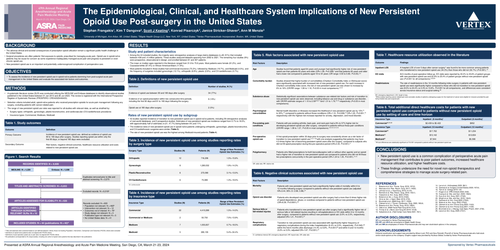
•Among the 44 included studies, the majority were retrospective analyses of large claims databases (n=40; 91%) that included between 438 and >4 million patients. These studies analyzed datasets spanning from 2002 to 2021. The remaining four studies (9%) were prospective, observational in design, and enrolled between 81 and 407 patients.
•The mean or median ages reported in the literature ranged from 31.8 to 75.9 years. Most patients were female (61.2%), and Caucasian/white (67.4%) or African American/black (11.9%).
•Most patients included in these studies had commercial insurance (75.2%), followed by Medicare (19.7%), and Medicaid (4.5%), and the frequency of surgeries included gynecologic (12.1%), orthopedic (6.9%), plastic (2.6%), and CV/cardiothoracic (0.7%).
Rates of new persistent opioid use by subgroup
•42 studies reported incidence of transition to new persistent opioid use in opioid-naïve patients, including 39 retrospective analyses of real-world databases, and 3 prospective studies. Estimates of new persistent opioid use incidence ranged from 0.7% to 18.5%, with approximately half of estimates (n=21, 47.7%) being between 6% and 11%.
•The incidence rates of new persistent opioid use in opioid-naïve patients undergoing orthopedic, gynecologic, plastic/reconstructive, and CV/cardiothoracic surgeries were similar (Table 3).
•The rate of new persistent opioid use was the highest among Medicaid-insured patients (Table 4).
Conclusions
•New persistent opioid use is a common complication of perioperative acute pain management that contributes to poor patient outcomes, increased healthcare resource utilization, and higher healthcare costs.
•These findings underscore the need for novel non-opioid therapeutics and comprehensive strategies to manage acute surgery-related pain.