457 posters, 2 videos, 2 audios, 8 topics, 45 sessions, 401 authors, 265 institutions
ePostersLive by SciGen Technologies S.A. All rights reserved.
49th Annual Regional Anesthesiology and Acute Pain Medicine Meeting
March 21-23, 2024 | The Hilton Bayfront San Diego | San Diego, California

5475
TRENDS IN PREOPERATIVE SELF-DISCLOSURE OF CANNABIS USE IN ADULT ORTHOPEDIC SURGICAL PATIENTS: AN INSTITUTIONAL RETROSPECTIVE STUDY
Poster Presenter
Authors
Affiliations
Part of Topic
Scientific Abstracts > Acute Pain
Trends in Preoperative Self-Disclosure of Cannabis Use in Adult Orthopedic Surgical Patients: An Institutional Retrospective Study
William Chan, MEng1, Marlena Komatz, BS1, Faye Rim, MD1-4, Dae Kim, MD1,3, Spencer Liu, MD1,3, Mary Kelly, NP1, Samuel Schuessler, MHA1,4, Roberta Stack, MS1,4, Seth Waldman, MD1,3, Alexandra Sideris, PhD1,3-5
1 Department of Anesthesiology, Critical Care & Pain Management, Hospital for Special Surgery, New York, NY
2 Department of Physiatry, Hospital for Special Surgery, New York, NY
3 Department of Anesthesiology, Weill Cornell Medicine, New York, NY
4 Pain Prevention Research Center, Hospital for Special Surgery, New York, NY
5 HSS Research Institute, Hospital for Special Surgery, New York, NY
Introduction
The legalization of cannabis for medical use (currently 38 states) and recreational use (currently 24 states) has been associated with an increased prevalence of use in the United States (US)1. In New York State (NYS), adult-use cannabis has been legal for medical purposes since 2014 and recreational purposes since 2021. Since the NYS Medical Cannabis Program (NYSMCP) was established in 2014, the number of adult patients with active registrations has increased to over 120,000 as of December 31st, 20222. These trends have important safety considerations in the perioperative setting as chronic or heavy preoperative cannabis use may increase the risk of intraoperative complications, postoperative nausea and vomiting (PONV), increased postoperative pain levels, and acute side effects associated with cannabis use cessation3,4. Recently published ASRA Pain Medicine consensus guidelines on the management of perioperative patients who use cannabis recommend universally screening to determine type, amount, frequency of use, route of administration and time of last use4. While medical cannabis prescriptions can be verified electronically using the NYS Prescription Monitoring Program (PMP), known as I-STOP, screening for non-prescription cannabis use is dependent on self-disclosure by patients. In this retrospective chart review study, we sought to determine the prevalence of self-reported cannabis use in the past 5-years at a single institution in New York City. We hypothesized that there is an increasing prevalence of preoperative self-reported cannabis use among adult patients undergoing orthopedic surgery.
Methods
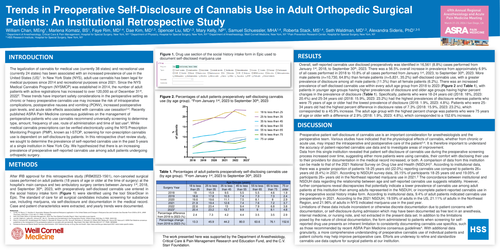
After IRB approval for this retrospective study (IRB#2023-1561), non-canceled surgical cases performed on adult patients (18 years of age or older at the time of surgery) at the hospital’s main campus and two ambulatory surgery centers between January 1st, 2018, and September 30th, 2023, with preoperatively self-disclosed cannabis use entered in the social history intake form (Figure 1) were identified using the tool SlicerDicer in Epic. The standard of care for all surgical candidates includes screening for substance use, including marijuana, via self-disclosure and documentation in the medical record. Case and patient characteristics were extracted, and yearly trends were documented.
Results
Overall, self-reported cannabis use disclosed preoperatively was identified in 16,561 (8.8%) cases performed from January 1st, 2018, to September 30th, 2023. There was a 56.5% overall increase in prevalence from approximately 6.9% of all cases performed in 2018 to 10.8% of all cases performed from January 1st, 2023, to September 30th, 2023. More male patients (n=10,730, 64.8%) than female patients (n=5,831, 35.2%) self-disclosed cannabis use, with a greater prevalence of disclosure among all male patients (11.3%) than all female patients (6.2%). There was an increased prevalence of self-disclosed cannabis use within every adult age group from 2018 to 2023 (Figure 2 and Table 1), with patients in younger age groups having higher prevalences of disclosure and older age groups having higher percent changes in the prevalence of disclosure (Table 1). Specifically, patients who were 18-24 years old (2018: 18%, 2023: 20.4%) and 25-34 years old (2018: 15.9%, 2023: 23.2%) had the highest prevalences of disclosure whereas patients who were 75 years of age or older had the lowest prevalence of disclosure (2018: 1.9%, 2023: 4.8%). Patients who were 25-34 years old had the highest percent difference in disclosure rates of 7.3% (2018: 15.9%, 2023: 23.2%), which corresponded to a 45.9% increase. The adult age group with the highest percent change was patients who were 75 years of age or older with a difference of 2.9% (2018: 1.9%, 2023: 4.8%), which corresponded to a 152.6% increase.
Discussion
Preoperative patient self-disclosure of cannabis use is an important consideration for anesthesiologists and the perioperative team. Various studies have indicated that the physiological effects of cannabis, whether from chronic or acute use, may impact the intraoperative and postoperative care of the patient3,4. It is therefore important to understand the accuracy of patient-reported cannabis use data and to investigate areas of improvement.
Data from this single institution revealed that patient self-disclosure of cannabis use during the preoperative screening process increased over time, suggesting either more patients were using cannabis, their comfort with disclosing their use to their providers for documentation in the medical record increased, or both. A comparison of data from this institution can be made to that of the 2021 National Survey on Drug Use and Health (NSDUH)5. According to institutional data, there was a greater proportion of patients 18-25 years old (22.0%) reporting cannabis use compared to patients 26+ years old (8.4%) in 2021. According to NSDUH survey data, 35.15% of participants 18-25 years old and 19.05% of participants 26+ years old in the Northeast reported marijuana use in 2021.2 The concordance between institutional and NSDUH data regarding the relationship between age and self-reported cannabis use suggests reliability. However, further comparisons reveal discrepancies that potentially indicate a lower prevalence of cannabis use among adult patients at this institution than among adults represented in the NSDUH, or incomplete patient-reported cannabis use in the preoperative social history intake form. According to institutional data, 9.4% of adult patients indicated cannabis use preoperatively in 2021. According to the 2021 NSDUH, 19.59% of adults in the US, 21.11% of adults in the Northeast Region, and 21.96% of adults in NYS indicated marijuana use in the past year.
Limitations of these data include inconsistent or otherwise discrete documentation due to patient concerns with documentation, or self-disclosure during admission which may have been documented as free text in an anesthesia, internal medicine, or nursing note, and not extracted in the present data set. In addition to the limitations posed by the nature of clinical documentation, the form administered to patients when screening for self-reported drug use presents an inherent limitation to consistently documenting cannabis use specifics, such as those recommended by recent ASRA Pain Medicine consensus guidelines4. With additional data granularity, a more comprehensive understanding of preoperative cannabis use of individual patients and patient cohorts may help improve perioperative care. Efforts are underway to refine and standardize cannabis use data capture for surgical patients at our institution.
References
- Cerda, M, Mauro, C, Hamilton A. Association Between Recreational Marijuana Legalization in the United States and Changes in Marijuana Use and Cannabis Use Disorder From 2008 to 2016. JAMA Psychiatry. 2020 Feb 1;77(2):165-171. PMID: 31722000.
- New York State Office of Cannabis Management. 2023 Two Year Medical Cannabis Report. https://cannabis.ny.gov/reports
- Lee BH, Sideris A, Ladha KS, Johnson RL, Wu CL. Cannabis and Cannabinoids in the Perioperative Period. Anesth Analg. 2022 May 13. PMID: 35551150.
- Shah S, Schwenk ES, Sondekoppam RV, Clarke H, Zakowski M, Rzasa-Lynn RS, Yeung B, Nicholson K, Schwartz G, Hooten WM, Wallace M, Viscusi ER, Narouze S. ASRA Pain Medicine consensus guidelines on the management of the perioperative patient on cannabis and cannabinoids. Reg Anesth Pain Med. 2023 Mar;48(3):97-117. PMID: 36596580.
- Substance Abuse and Mental Health Services Administration. 2021 National Survey on Drug Use and Health. https://www.samhsa.gov/data/report/2021-nsduh-state-specific-tables.
The work presented here was supported by the Department of Anesthesiology, Critical Care & Pain Management Research and Education Fund, and the C.V. Starr Foundation.