457 posters, 2 videos, 2 audios, 8 topics, 45 sessions, 401 authors, 265 institutions
ePostersLive by SciGen Technologies S.A. All rights reserved.
49th Annual Regional Anesthesiology and Acute Pain Medicine Meeting
March 21-23, 2024 | The Hilton Bayfront San Diego | San Diego, California

5467
PUBLIC PERCEPTION OF HEALTHCARE, ANESTHESIA AND CLIMATE CHANGE
Poster Presenter
Authors
Affiliations
Part of Topic
Scientific Abstracts > Acute Pain
Public perception of healthcare, anesthesia, and climate change
Ava Zardynezhad, Jenice Ma, Rakesh Sondekoppam, Vivian Ip
INTRODUCTION
•Healthcare is a significant contributor to the national Greenhouse Gas emissions, ORs being some of the most resource-intensive sub-sectors.
•The aim of this study was to investigate the perception of patients and their family members of the intersectionality of climate change and healthcare.
•Additionally investigated whether perceptions and attitudes translated into choosing anesthesia options with different environmental footprints.
METHODS
•Participants meeting inclusion and exclusion criteria were interviewed using a standard set of 9 questions.
•The survey queried participants on demographic information, perceptions of climate change, perceptions of the health impacts of climate change, knowledge of healthcare and its impact on climate change, and willingness to learn more about climate change and the healthcare system.
•For normally distributed continuous data, mean and standard deviation were used.
•For ordinal and interval data such as survey responses, Chi-square test was used.
RESULTS
•320 participants included in final analysis; demographic information shown in Table 1.
•32% of participants were aware that healthcare greatly contributes to climate change, a larger majority of patients (82.5%) thought healthcare contributes to climate change in some form.
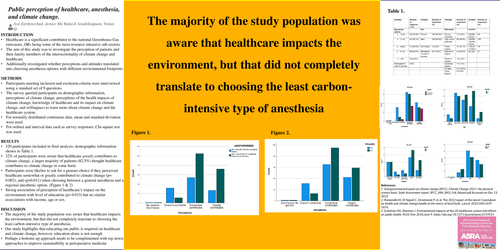
•Participants were likelier to ask for a greener choice if they perceived healthcare somewhat or greatly contributed to climate change (p= 0.002), and (p=0.011) when choosing between a general anesthesia and a regional anesthetic option. (Figure 1 & 2)
•Strong association of perception of healthcare’s impact on the environment with level of education (p= 0.015) but no similar associations with income, age or sex.
DISCUSSION
•The majority of the study population was aware that healthcare impacts the environment, but that did not completely translate to choosing the least carbon-intensive type of anesthesia.
•Our study highlights that educating our public is required on healthcare and climate change, however, education alone is not enough.
•Perhaps a bottoms up approach needs to be complimented with top down approaches to improve sustainability in perioperative medicine