457 posters, 2 videos, 2 audios, 8 topics, 45 sessions, 401 authors, 265 institutions
ePostersLive by SciGen Technologies S.A. All rights reserved.
49th Annual Regional Anesthesiology and Acute Pain Medicine Meeting
March 21-23, 2024 | The Hilton Bayfront San Diego | San Diego, California

5136
THE ROLE OF SHORT-TERM LONG-ACTING HYDROMORPHONE IN ACUTE PAIN MANAGEMENT FOLLOWING OPEN ABDOMINAL UROLOGIC SURGERIES
Poster Presenter
Authors
Affiliations
Part of Topic
Scientific Abstracts > Acute Pain
The role of short-term long-acting hydromorphone in acute pain management following open abdominal urologic surgeries
BACKGROUND
•The use of long-acting opioids has been reduced due to the risk of adverse events and overdose when used for chronic pain. 1, 2
•Evidence is lacking to support the short-term use of a low dose long-acting opioid for acute pain control in a monitored setting.
•Objective: to evaluate whether low dose, long-acting hydromorphone short term (two days) combined with short-acting hydromorphone as required offers better pain control post-operatively to allow earlier ambulation after major urologic surgeries compared to short-acting opioid alone.
METHODS
•Randomized, double-blind, controlled trial assessed all adult patients undergoing elective open abdominal urologic surgeries who met the inclusion criteria. Patients were divided into two groups:
•LA: Long-acting hydromorphone on a regular basis for two days with short-acting hydromorphone available on an ‘as required’ basis.
•SA: Short-acting hydromorphone on an ‘as required’ basis only.
RESULTS
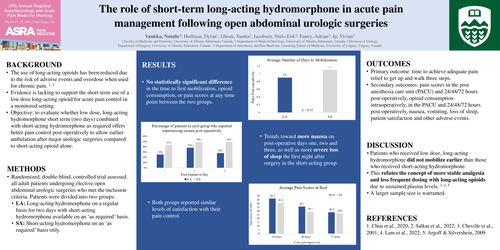
•No statistically significant difference in the time to first mobilization, opioid consumption, or pain scores at any time point between the two groups.
•Trends toward more nausea on post-operative days one, two and three, as well as more severe loss of sleep the first night after surgery in the short-acting group.
•Both groups reported similar levels of satisfaction with their pain control.
OUTCOMES
•Primary outcome: time to achieve adequate pain relief to get up and walk three steps.
•Secondary outcomes: pain scores in the post anesthesia care unit (PACU) and 24/48/72 hours post-operatively, opioid consumption intraoperatively, in the PACU and 24/48/72 hours post-operatively, nausea, vomiting, loss of sleep, patient satisfaction and other adverse events.
DISCUSSION
•Patients who received low dose, long-acting hydromorphone did not mobilize earlier than those who received short-acting hydromorphone.
•This refutes the concept of more stable analgesia and less frequent dosing with long-acting opioids due to sustained plasma levels. 3, 4, 5
•A larger sample size is warranted.
REFERENCES
1. Chua et al., 2020; 2. Salkar et al., 2022; 3. Cheville et al., 2001; 4. Lam et al., 2022; 5. Argoff & Silvershein, 2009