457 posters, 2 videos, 2 audios, 8 topics, 45 sessions, 401 authors, 265 institutions
ePostersLive by SciGen Technologies S.A. All rights reserved.
49th Annual Regional Anesthesiology and Acute Pain Medicine Meeting
March 21-23, 2024 | The Hilton Bayfront San Diego | San Diego, California

5254
PHASE I RECOVERY OPIOID CONSUMPTION FOLLOWING UNILATERAL TOTAL KNEE ARTHROPLASTY STRATIFIED BY RACE: A SINGLE CENTER STUDY
Poster Presenter
Authors
Affiliations
Part of Topic
Scientific Abstracts > Acute Pain
Phase I recovery opioid consumption following unilateral total knee arthroplasty stratified by race: a single center study
Roxana Farokhnia, Emily H Garmon, Bryce C Allen, Michael R Fettiplace, Chandni Raiyani, Michael P Hofkamp
Introduction
▪
Total knee arthroplasty (TKA) is a common orthopedic procedure that is associated with higher levels of pain and opioid use in the immediate postoperative period than other joint arthroplasties.
▪
Worse pain and symptoms for racial minorities compared to White patients have been reported postoperatively for TKA.
▪
We hypothesize that racial disparities exist in the morphine milligram equivalent (MME) consumption during Phase I recovery following unilateral TKA.
Methods
▪
Included patients who underwent unilateral TKA from January 1, 2018 to December 31, 2022 who identified as White or Caucasian (N=177), Black or African American (N=184), or Hispanic (N=193) at Baylor Scott and White - Temple.
▪
Phase I recovery time was defined as the time from when Phase I recovery started until the time the patients met discharge criteria
▪
Morphine milligram equivalent (MME) was calculated using the criteria described by Nielsen et al.
Results
▪
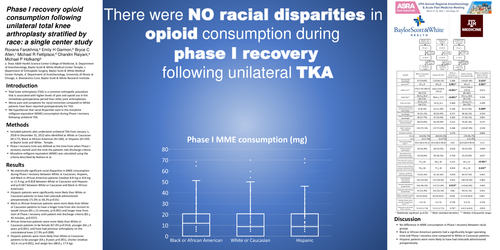
No statistically significant racial disparities in MME consumption during Phase I recovery between White or Caucasian, Hispanic, and Black or African American patients (median 8.8 mg vs 8.8 mg vs 11.9 mg; p=0.818 between White or Caucasian and Hispanic and p=0.667 between White or Caucasian and Black or African American)
▪
Hispanic patients were significantly more likely than White or Caucasian patients to have had celecoxib administered preoperatively (71.0% vs 58.2% p=0.01)
▪
Black or African American patients were more likely than White or Caucasian patients to have a longer time from skin incision to would closure (85 + 22 minutes, p<0.001) and longer time from start of Phase I recovery until patient met discharge criteria (85 + 43 minutes, p=0.037).
▪
African American patients were more likely than White or Caucasian patients to be female (67.4% p=0.014), younger (64 + 9 years p=0.001), and have had previous arthroplasty on the contralateral knee (17.9% p=0.008).
▪
Hispanic patients were more likely than White or Caucasian patients to be younger (64 + 8 years p=0.001), shorter (median 162.6 cm p<0.001), and weigh less (88.8 + 17.9 kg).