457 posters, 2 videos, 2 audios, 8 topics, 45 sessions, 401 authors, 265 institutions
ePostersLive by SciGen Technologies S.A. All rights reserved.
49th Annual Regional Anesthesiology and Acute Pain Medicine Meeting
March 21-23, 2024 | The Hilton Bayfront San Diego | San Diego, California

5126
CANNABIS USE IN ADOLESCENT ORTHOPEDIC SURGICAL PATIENTS: AN INSTITUTIONAL RETROSPECTIVE STUDY
Poster Presenter
Authors
Affiliations
Part of Topic
Scientific Abstracts > Acute Pain
Introduction
Many adolescents experiment with cannabis. Prevalence of use in the last 12 months among 8th, 10th, and 12th graders was 8%, 17.8% and 29% respectively [1]. Though reported use from national samples has remained relatively constant over the last 25 years except for significant decreases during the pandemic, the perceived risk of regular cannabis use has declined in this age group. With the increasing legalization of cannabis for medical and adult use purposes across the United States, it is important that medical providers appropriately screen all patient populations. Cannabis use in the perioperative period may impact the effect of anesthetics and potentially increase morbidity. The prevalence of substance use in adolescent surgical patients is poorly described. The aim of this retrospective chart review was to determine the prevalence of self-reported cannabis use at a single urban, high-volume orthopedic surgery hospital over the last 5 years.
Material and Methods
After IRB approval for this retrospective study (IRB#2023-1561), surgical cases performed on adolescent patients (12 to less than 18 years of age at the time of surgery) at the hospital’s main campus and two ambulatory surgery centers between January 1st, 2018, and September 30th, 2023, with preoperatively self-disclosed and documented cannabis use were identified using the SlicerDicer tool in Epic. The search logic returned surgical cases that were not canceled and for which cannabis (marijuana) use was disclosed and documented in Epic before surgery. Case and patient characteristics of those who did and did not self-disclose were extracted from the medical record, and descriptive statistics were used to summarize the findings.
Results
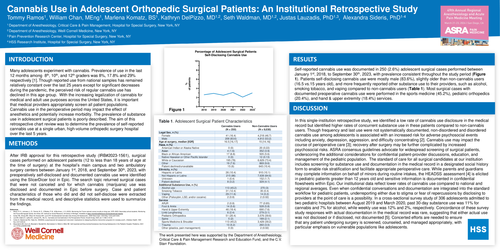
Self-reported cannabis use was documented in 250 (2.6%) adolescent surgical cases performed between January 1st, 2018, to September 30th, 2023, with prevalence consistent throughout the study period (Figure 1). Patients self-disclosing cannabis use were mostly male (83.6%), slightly older than non-cannabis users (16.5 vs.15 years old), and more frequently reported other substance use to their providers, such as alcohol, smoking tobacco, and vaping compared to non-cannabis users (Table 1). Most surgical cases with documented preoperative cannabis use were performed in the sports medicine (45.2%), pediatric orthopedics (20.4%), and hand & upper extremity (18.4%) services.
Discussion
In this single-institution retrospective study, we identified a low rate of cannabis use disclosure in the medical record but identified higher rates of concurrent substance use in these patients compared to non-cannabis users. Though frequency and last use were not systematically documented, non-disordered and disordered cannabis use among adolescents is associated with an increased risk for adverse psychosocial events including anxiety, depression, aggression, and difficulty concentrating [2]. Cannabis use may impact the course of perioperative care [3]; recovery after surgery may be further complicated by increased psychosocial risks. ASRA consensus guidelines advocate for widespread screening of surgical patients, underscoring the additional considerations for confidential patient-provider discussions, education, and management of the pediatric population. The standard of care for all surgical candidates at our institution includes screening for substance use and documentation in the medical record in a designated social history form to enable risk stratification and facilitate appropriate perioperative care. While parents and guardians may complete information on behalf of minors during routine intakes, the HEADSS assessment [4] is elicited in pediatric patients greater than 12 years old and sensitive information is documented in confidential flowsheets within Epic. Our institutional data reflect lower rates of cannabis use compared to national and regional averages. Even when confidential conversations and documentation are integrated into the standard workflow for pediatric patients, underreporting either due to stigma or fear of repercussions by disclosing to providers at the point of care is a possibility. In a cross-sectional survey study of 306 adolescents admitted to two pediatric hospitals between August 2019 and March 2020, past 30-day substance use was 11% for cannabis and 7% for alcohol, while weekly use was 12% and 2%, respectively. Concordance of these survey study responses with actual documentation in the medical record was rare, suggesting that either actual use was not disclosed or if disclosed, not documented [5]. Concerted efforts are needed to ensure that any patient undergoing surgery is screened, counseled, and managed appropriately, with particular emphasis on vulnerable populations like adolescents.
References
- Miech, R. A., Johnston, L. D., Patrick, M. E., O’Malley, P. M., & Bachman, J. G. (2023). Monitoring the Future national survey results on drug use, 1975–2023: Secondary school students. Monitoring the Future Monograph Series. Ann Arbor, MI: Institute for Social Research, University of Michigan. Available at https://monitoringthefuture.org/results/annual-reports/
- Sultan RS, Zhang AW, Olfson M, Kwizera MH, Levin FR. Nondisordered Cannabis Use Among US Adolescents. JAMA Netw Open. 2023 May 1;6(5):e2311294.
- Lee BH, Sideris A, Ladha KS, Johnson RL, Wu CL. Cannabis and Cannabinoids in the Perioperative Period. Anesth Analg. 2024 Jan 1;138(1):16-30.
- Cohen E, Mackenzie RG, Yates GL. HEADSS, a psychosocial risk assessment instrument: implications for designing effective intervention programs for runaway youth. J Adolesc Health. 1991 Nov;12(7):539-44.
- Masonbrink AR, Hunt JA, Bhandal A, Randell KA, Mermelstein S, Wells S, Miller MK. Self-reported and Documented Substance Use Among Adolescents in the Pediatric Hospital. Pediatrics. 2021 Jun;147(6):e2020031468.