457 posters, 2 videos, 2 audios, 8 topics, 45 sessions, 401 authors, 265 institutions
ePostersLive by SciGen Technologies S.A. All rights reserved.
49th Annual Regional Anesthesiology and Acute Pain Medicine Meeting
March 21-23, 2024 | The Hilton Bayfront San Diego | San Diego, California

5553
POSTOPERATIVE PAIN TRAJECTORIES AFTER ONCOLOGIC BREAST SURGERY: A SYSTEMATIC REVIEW AND META-ANALYSIS
Poster Presenter
Authors
Affiliations
Part of Topic
Scientific Abstracts > Acute Pain
Postoperative Pain Trajectories After Oncologic Breast Surgery: A Systematic Review and Meta-Analysis
Rebecca Xu, Laurenz Hauptmann, Sheila Gokul, Kara Fields, Philipp Lirk, Kristin Schreiber
Brigham and Women's Hospital, Harvard Medical School
Introduction
Oncologic breast surgery is associated with significant postoperative pain, with previous studies reporting variable incidence of moderate-severe acute and persistent pain among individuals(1-4). Although many well-established analgesic interventions are used in practice, there is no consensus on an optimal analgesic regimen. This systematic review aims to construct average pain trajectories across all patients undergoing these procedures, in order to identify critical time points of high postoperative pain, and evaluate differences in trajectory under various analgesic approaches.
Materials and Methods
Six electronic databases were systematically searched for randomized controlled trials and meta-analyses published between May 31, 2006 and July 15, 2021. Overall, 129 studies with 8,288 patients undergoing oncologic breast surgery were identified as eligible. Pain scores at rest and with movement were extracted from each study, grouping patients based according to a set of analgesic modalities, reporting average pain score trajectories across the acute postoperative period and out to one year after surgery. These average pain curves were constructed for patients receiving 1) basic analgesia, defined as treatment with only NSAIDs, nefopam, acetaminophen, opioids, or combinations of these drugs); 2) multimodal analgesia, defined as additional adjuncts including intravenous lidocaine, dexmedetomidine, clonidine, metamizole, magnesium, ketamine, or duloxetine; 3) intravenous dexamethasone; 4) gabapentinoids; a variety of regional anesthesia techniques including 5) erector spinae block (ESPB), 6) paravertebral block (PVB), 7) serratus anterior plane block (SAPB), and 8) pectoralis block (PECS); and 9) wound infiltration. Dexamethasone and gabapentinoids were evaluated separately from multimodal analgesia due to high volume of studies for these specific medications. As this study utilized previously collected data and publications, it was exempt from IRB review according to the Mass General Brigham policy.
Results/Case Report
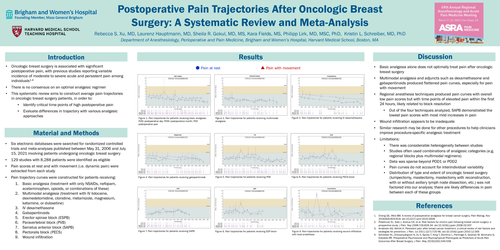
For patients receiving basic analgesia, average pain remained low to moderate in the initial postoperative period, followed by a gradual decline in the first postoperative week. The trajectory of pain with movement was similar to pain at rest, though with overall higher pain scores including average values in the moderate range within the first 18 hours. The average pain curve for multimodal analgesia showed generally low pain scores with gradual decline, and notably, average pain scores were similar for pain at rest and pain with movement.
Intravenous dexamethasone and gabapentinoids produced similar pain curves as multimodal analgesia. Pain curves for each of the four regional anesthesia techniques overall showed low to moderate pain scores. However, unlike the other three techniques, the SAPB did not show acute elevations of pain into the moderate range. Mean pain scores after wound infiltration were relatively high, with scores reaching the severe range within the first 18 hours after surgery.
Discussion
These pain trajectories suggest that basic analgesia alone does not optimally treat pain after breast cancer surgery. Multimodal analgesia and adjuncts such as dexamethasone and gabapentinoids produced flattened pain curves, especially for pain with movement. Regional anesthesia techniques produced pain curves with overall low pain scores but there were time points of elevated pain. Wound infiltration appears to be inadequate for treating postoperative pain, though it may be considered as an adjunct with other agents. With this review, we hope to encourage further research to investigate gaps in knowledge regarding procedure-specific pain management and, therefore, help clinicians improve procedure-specific analgesic treatment. Importantly, while these average pain curves can help identify difficult analgesic transitions, uncover critical timepoints for interventions, and establish a gold standard analgesia protocol for patients undergoing surgery for breast cancer, they do not account for interindividual variability in pain trajectory. Future studies should also consider patient-level factors, which may help explain inter-individual variability, and identify factors related to higher pain among a group of individuals undergoing the same procedure, and allow targeting of those who are at relatively higher risk.
References
1. Cheng GS, Ilfeld BM. A review of postoperative analgesia for breast cancer surgery. Pain Manag. Nov 2016;6(6):603-618. doi:10.2217/pmt-2015-0008
2. Poleshuck EL, Katz J, Andrus CH, et al. Risk factors for chronic pain following breast cancer surgery: a prospective study. J Pain. Sep 2006;7(9):626-34. doi:10.1016/j.jpain.2006.02.007
3. Andersen KG, Kehlet H. Persistent pain after breast cancer treatment: a critical review of risk factors and strategies for prevention. J Pain. Jul 2011;12(7):725-46. doi:10.1016/j.jpain.2010.12.005
4. Schreiber KL, Zinboonyahgoon N, Xu X, Spivey T, King T, Dominici L, Partridge A, Golshan M, Strichartz G, Edwards RR. Preoperative Psychosocial and Psychophysical Phenotypes as Predictors of Acute Pain Outcomes After Breast Surgery. J Pain. May 2019;20(5):540-556