457 posters, 2 videos, 2 audios, 8 topics, 45 sessions, 401 authors, 265 institutions
ePostersLive by SciGen Technologies S.A. All rights reserved.
49th Annual Regional Anesthesiology and Acute Pain Medicine Meeting
March 21-23, 2024 | The Hilton Bayfront San Diego | San Diego, California

5453
A CASE OF SUCCESSFUL MULTIMODAL PAIN CONTROL AFTER COMPLEX SCAPULECTOMY SURGERY UTILIZING A COMBINATION OF NERVE BLOCKS
Poster Presenter
Authors
Part of Topic
Scientific Abstracts > Acute Pain
Introduction
•Scapulectomy presents unique challenges in terms of perioperative pain management and postoperative recovery.
•Traditional approaches to anesthesia have often involved general anesthesia combined with opioid-based analgesia, leading to potential complications and prolonged recovery periods.
•Regional anesthesia has emerged as a promising alternative, offering effective pain control and reducing the risks associated with systemic opioids.
Case Report
•87 years old male with a history of HTN, DLD, TIA, BPH and left chest melanoma with subsequent resection 43 years ago, who presents with an incidental finding of metastatic clear cell renal cell carcinoma to right scapula.
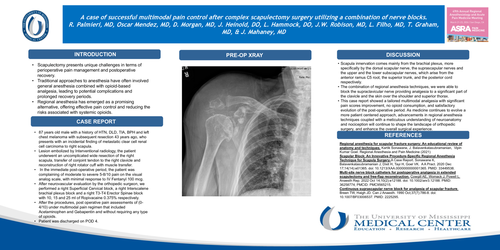
•Lesion embolized by Interventional radiology, the patient underwent an uncomplicated wide resection of the right scapula, transfer of conjoint tendon to the right clavicle and reconstruction of right rotator cuff with muscle transfer.
• In the immediate post-operative period, the patient was complaining of moderate to severe 5-8/10 pain on the visual analog scale, with minimal response to IV Fentanyl 100 mcg.
•After neurovascular evaluation by the orthopedic surgeon, we performed a right Superficial Cervical block, a right Interscalene brachial plexus block and a right T3-T4 Erector Spinae block with 10, 15 and 25 ml of Ropivacaine 0.375% respectively.
•After the procedures, post operative pain assessments of (0-4/10) under multimodal pain regimen that included Acetaminophen and Gabapentin and without requiring any type of opioids.
•Patient was discharged on POD 4.
Discussion
•Scapula innervation comes mainly from the brachial plexus, more specifically by the dorsal scapular nerve, the suprascapular nerves and the upper and the lower subscapular nerves, which arise from the anterior ramus C5 root, the superior trunk, and the posterior cord respectively.
•The combination of regional anesthesia techniques, we were able to block the supraclavicular nerve providing analgesia to a significant part of the clavicle and the skin over the shoulder and superior thorax.
•This case report showed a tailored multimodal analgesia with significant pain scores improvement, no opioid consumption, and satisfactory evolution of the post-operative period. As medicine continues to evolve a more patient centered approach, advancements in regional anesthesia techniques coupled with a meticulous understanding of neuroanatomy and nociception will continue to shape the landscape of orthopedic surgery, and enhance the overall surgical experience.