457 posters, 2 videos, 2 audios, 8 topics, 45 sessions, 401 authors, 265 institutions
ePostersLive by SciGen Technologies S.A. All rights reserved.
49th Annual Regional Anesthesiology and Acute Pain Medicine Meeting
March 21-23, 2024 | The Hilton Bayfront San Diego | San Diego, California

5388
CO-PRESCRIPTION OF NALOXONE AMONG PATIENTS PRESCRIBED OPIOIDS AFTER INPATIENT STAYS
Poster Presenter
Authors
Affiliations
Part of Topic
Scientific Abstracts > Acute Pain
Co-prescription of Naloxone Among Patients Prescribed Opioids After Inpatient Stays
Introduction
While prescription opioids are commonly used to treat pain after injury or surgery, it has been demonstrated that patients receiving higher doses upon discharge are at increased risk of opioid overdose. [1-2] Although naloxone (an opioid antagonist) has been used to reverse opioid overdoses and has become more readily available [3], it is unknown how frequently providers co-prescribe naloxone alongside an opioid prescription. We assessed the co-prescription trend of naloxone with an opioid within 28 days after an inpatient discharge. We hypothesized that from 2015 to 2021, there would be an increase in the proportion of inpatient discharges with a co-prescription of naloxone alongside an opioid.
Methods
This study was approved by the Institutional Review Board at our hospital (IRB#2017-0169). The requirement for written informed consent was waived given the de-identified nature of the data. Using the Truven Health MarketScan database from 2015 to 2021 (Truven Health Analytics, Inc., IBM, Armonk, NY, USA), we identified patients who filled an opioid prescription within 28 days of an inpatient discharge and further identified those with a naloxone prescription within the same 28-day period. Descriptive statistics were stratified by opioids-only and opioids+naloxone prescription ≤28 days after discharge. Variables included age, sex, region, insurance type, length of stay, and discharge status. Year of discharge was included to identify potential trends during the study period.
Results
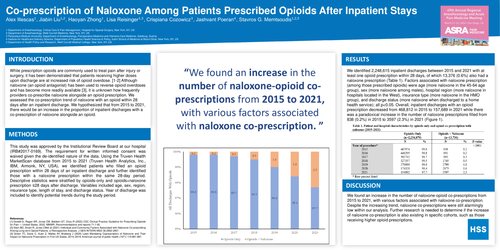
We identified 2,248,615 inpatient discharges between 2015 and 2021 with at least one opioid prescription within 28 days, of which 13,376 (0.6%) also had a naloxone prescription (Table 1). Factors associated with naloxone prescription (among those prescribed opioids) were age (more naloxone in the 45-64 age group), sex (more naloxone among males), hospital region (more naloxone in hospitals located in the West), insurance type (more naloxone in the HMO group), and discharge status (more naloxone when discharged to a home health service); all p<0.05. Overall, inpatient discharges with an opioid prescription decreased from 468,812 in 2015 to 157,689 in 2021 while there was a paradoxical increase in the number of naloxone prescriptions filled from 838 (0.2%) in 2015 to 3597 (2.3%) in 2021 (Figure 1).
Discussion
We found an increase in the number of naloxone-opioid co-prescriptions from 2015 to 2021, with various factors associated with naloxone co-prescription. Despite the increasing trend, naloxone co-prescriptions were still alarmingly low within our analysis. Further research is needed to determine if the increase of naloxone co-prescription is also existing in specific cohorts, such as those receiving higher opioid prescriptions.