457 posters, 2 videos, 2 audios, 8 topics, 45 sessions, 401 authors, 265 institutions
ePostersLive by SciGen Technologies S.A. All rights reserved.
49th Annual Regional Anesthesiology and Acute Pain Medicine Meeting
March 21-23, 2024 | The Hilton Bayfront San Diego | San Diego, California

5088
PROCEDURE-SPECIFIC ACUTE PAIN TRAJECTORIES AFTER SHOULDER SURGERY
Poster Presenter
Authors
Affiliations
Part of Topic
Scientific Abstracts > Acute Pain
Procedure-Specific Acute Pain Trajectories After Shoulder Surgery
INTRODUCTION: Shoulder surgery is common and associated with significant and prolonged postoperative pain. Over 45,000 shoulder replacements and over 270,000 rotator cuff repairs are performed annually in the US.1 Pain scores after shoulder surgery often reach severe levels when relying on oral and intravenous analgesics only, and opioid requirements can be high.2 Understanding the average pain trajectory under different standard analgesic regimens may inform not only which analgesic regimen is generally most effective, but also the optimal timing of regional anesthesia interventions.
METHODS: We performed a systematic review of randomized controlled trials (RCTs) and cohort studies published between January 1987 and April 2018 assessing pain scores after shoulder surgery according to the Preferred Reporting Items for Systematic Reviews and Meta-Analyses (PRISMA) guidelines using PUBMED. This systematic review was registered in the International Prospective Register of Systematic Reviews (PROSPERO; NHS; ID: CRD42018096724). As this study is devoid of patient identifiable information, it was exempt from IRB review requirements according to the Mass General Brigham policy. Pain score means and standard deviations were extracted or approximated from each study at each time point.4 Pain scores from different studies were combined and weighted according to study sample size, and an average pain score at each time point was calculated using the metamean function in R package meta. All reported p-values were two-tailed and unadjusted. To compare pain scores between groups at each time point, we used z-test.5 To account for multiple comparisons across 12 timepoints examined, we considered a p value <0.00417 as statistically significant (Bonferroni correction). All reported P-values are unadjusted.
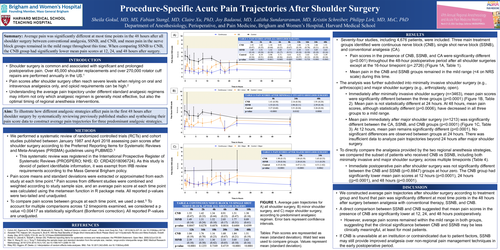
RESULTS: Seventy-four studies, including 4,676 patients, were included. Three main treatment groups identified were continuous nerve block (CNB), single shot nerve block (SSNB), and conventional analgesia (CA). Pain scores in the presence of CNB, SSNB, and CA were significantly different (p<0.001)throughout the 48-hour postoperative period after all shoulder surgeries except at the 16-hour timepoint (p=.2726) (Figure 1A, Table 1). Mean pain in the CNB and SSNB groups remained in the mild range (<4 on NRS scale) during this time. The analysis was further subdivided into minimally invasive shoulder surgery (e.g., arthroscopic) and major shoulder surgery (e.g., arthroplasty, open). Immediately after minimally invasive shoulder surgery (n=3463), mean pain scores were significantly different between the three groups (p<0.0001) (Figure 1B, Table 2). Mean pain is not statistically different at 24 hours. At 48 hours, mean pain scores, although statistically different (p=0.0006), have decreased in all three groups to a mild range. Mean pain immediately after major shoulder surgery (n=1213) was significantly different between the CA, SSNB, and CNB groups (p<0.0001) (Figure 1C, Table 3). At 12 hours, mean pain remains significantly different (p<0.0001). No significant differences are observed between groups at 24 hours. There was insufficient data to analyze pain trajectories beyond 24 hours after major shoulder surgery. To directly compare the analgesia provided by the two regional anesthesia strategies, we compared the subset of patients who received CNB vs SSNB, including both minimally invasive and major shoulder surgery, across multiple timepoints (Table 4). Immediate postoperative pain after shoulder surgery was not significantly different between the CNB and SSNB (p=0.8847) groups at hour zero. The CNB group had significantly lower mean pain scores at 12 hours (p<0.0001), 24 hours ((p<0.0001), and 48 hours (p<0.0001).