457 posters, 2 videos, 2 audios, 8 topics, 45 sessions, 401 authors, 265 institutions
ePostersLive by SciGen Technologies S.A. All rights reserved.
49th Annual Regional Anesthesiology and Acute Pain Medicine Meeting
March 21-23, 2024 | The Hilton Bayfront San Diego | San Diego, California

5133
THE EFFECT OF MUSIC THERAPY INTERVENTION ON PAIN AND ANXIETY IN ADULT PATIENT UNDERGOING TOTAL SHOULDER ARTHROPLASTY
Poster Presenter
Authors
Affiliations
Part of Topic
Scientific Abstracts > Acute Pain
The Effect of Music Therapy Intervention on Pain and Anxiety in Adult Patient Undergoing Total Shoulder Arthroplasty
Introduction
•Despite multimodal pain management strategies for patients undergoing shoulder surgery, many patients still experience significant post-surgical pain following their procedures.
•Post-surgical pain has profound effects on patients’ recovery process and overall long-term outcomes.
•The purpose of this study was to investigate if music therapy interventions would reduce pre- and post-operative pain and anxiety in patients undergoing total shoulder arthroplasties as compared with patients who received standard of care without music therapy.
Methods
•Patients were prospectively identified from a list of scheduled elective shoulder surgeries.
•Consented patients were randomized into 3 groups— live music therapy, recorded music therapy, and control (no music therapy).
•All patients completed the PROMIS Emotional Distress-Anxiety-Short Form and Pain Scale Survey at:
•Pre-operative visit (Visit 1)
•Day of surgery before pre-surgical anesthesia (Visit 2)
•Post-surgery in the post-anesthesia care unit (Visit 3),
•12-24 hours after surgery (Visit 4),
•2 weeks post-surgery (Visit 5),
•6 months post-surgery (Visit 6).
Results
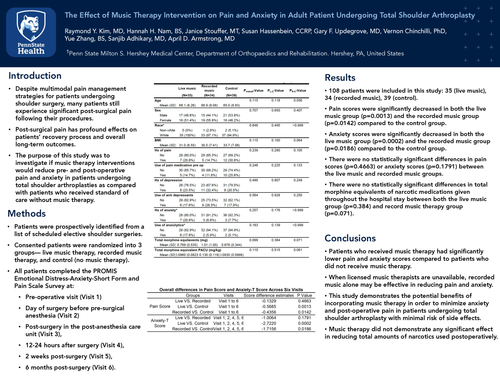
•108 patients were included in this study: 35 (live music), 34 (recorded music), 39 (control).
•Pain scores were significantly decreased in both the live music group (p=0.0013) and the recorded music group (p=0.0142) compared to the control group.
•Anxiety scores were significantly decreased in both the live music group (p=0.0002) and the recorded music group (p=0.0186) compared to the control group.
•There were no statistically significant differences in pain scores (p=0.4663) or anxiety scores (p=0.1791) between the live music and recorded music groups.
•There were no statistically significant differences in total morphine equivalents of narcotic medications given throughout the hospital stay between both the live music group (p=0.384) and record music therapy group (p=0.071).
Conclusions
•Patients who received music therapy had significantly lower pain and anxiety scores compared to patients who did not receive music therapy.
•When licensed music therapists are unavailable, recorded music alone may be effective in reducing pain and anxiety.
•This study demonstrates the potential benefits of incorporating music therapy in order to minimize anxiety and post-operative pain in patients undergoing total shoulder arthroplasty with minimal risk of side effects.
•Music therapy did not demonstrate any significant effect in reducing total amounts of narcotics used postoperatively.