457 posters, 2 videos, 2 audios, 8 topics, 45 sessions, 401 authors, 265 institutions
ePostersLive by SciGen Technologies S.A. All rights reserved.
49th Annual Regional Anesthesiology and Acute Pain Medicine Meeting
March 21-23, 2024 | The Hilton Bayfront San Diego | San Diego, California

5555
A PROSPECTIVE OBSERVATIONAL STUDY OF CONTINUOUS PERIPHERAL NERVE BLOCK FAILURES
Poster Presenter
Authors
Affiliations
Part of Topic
Scientific Abstracts > Acute Pain
Introduction:
•Continuous peripheral nerve blocks (CPNBs) play a vital role in postoperative pain management and enhance patient recovery
•CPNB failures have profound affects on patient care such as unanticipated or poorly controlled pain, increased need for opioids, and delayed hospital discharge or readmission
•CPNB failure can be due to either a primary reason (i.e., incorrect placement) or secondary reasons (i.e., displacement, obstruction, or disconnection)
•Varied definitions of CPNB failure and use of subjective versus objective data hinders accurate assessment of failure rates.
•Existing literature describes failure rates for upper extremity nerve catheters to be 19-26%
•The primary objective of this study was to assess the inpatient CPNB failure rates for upper extremity, lower extremity, and truncal nerve blocks.
•A failure was counted if CPNB was replaced following patient evaluation
•We also evaluated the different causes of failure, mainly catheter migration
•We hope to identify the factors that contribute to CPNB failures in a busy academic practice in order to better inform a change in practice that will lead to decrease in failure rates
Methods:
•Prospective observational study
•Patients were followed over a two year period (May 2021 and March 2023) were reviewed
•Inclusion criteria included all patients over 18 years old who received a peripheral nerve block catheter
•Collected data included acute pain procedure performed, medical personnel who performed procedure, post-procedure day when CPNB was replaced, and documentation of ultrasound use to verify catheter migration
•Descriptive statistics were employed to summarize demographic characteristics
• CPNB that were replaced due to factors such as removed for reducing infection risk, inadvertent removal by the patient, removed for MRI, or removed intraoperatively by surgical team were excluded from the analysis. This accounted for 19 out of 4,044 CPNBs.
Results:
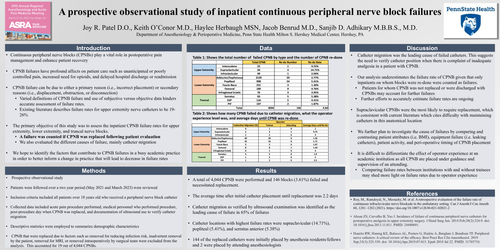
•A total of 4,044 CPNB were performed and 146 blocks (3.61%) failed and necessitated replacement.
•The average time after initial catheter placement until replacement was 2.2 days
•Catheter migration as verified by ultrasound examination was identified as the leading cause of failure in 65% of failures
•Catheter locations with highest failure rates were supraclavicular (14.71%), popliteal (5.41%), and serratus anterior (5.38%)
•144 of the replaced catheters were initially placed by anesthesia residents/fellows and 2 were placed by attending anesthesiologists
Discussion:
•Catheter migration was the leading cause of failed catheters. This suggests the need to verify catheter position when there is complaint of inadequate analgesia in a patient with CPNB.
•Our analysis underestimates the failure rate of CPNB given that only inpatients on whom blocks were re-done were counted as failures.
•Patients for whom CPNB was not replaced or were discharged with CPNBs may account for further failures
•Further efforts to accurately estimate failure rates are ongoing
•Supraclavicular CPNBs were the most likely to require replacement, which is consistent with current literature which cites difficulty with maintaining catheters in this anatomical location
•We further plan to investigate the cause of failures by comparing and contrasting patient attributes (i.e. BMI), equipment failure (i.e. leaking catheters), patient activity, and peri-operative timing of CPNB placement
•It is difficult to differentiate the effect of operator experience at an academic institution as all CPNB are placed under guidance and supervision of an attending.
•Comparing failure rates between institutions with and without trainees may shed more light on failure rates due to operator experience