457 posters, 2 videos, 2 audios, 8 topics, 45 sessions, 401 authors, 265 institutions
ePostersLive by SciGen Technologies S.A. All rights reserved.
49th Annual Regional Anesthesiology and Acute Pain Medicine Meeting
March 21-23, 2024 | The Hilton Bayfront San Diego | San Diego, California

5211
UTILIZATION OF ANALGESIC TECHNIQUES AND OUTCOMES FOR THORACIC TRAUMA – A NATIONAL SAMPLE USING THE PREMIER HEALTH DATABASE
Poster Presenter
Authors
Affiliations
Part of Topic
Scientific Abstracts > Acute Pain
Utilization of Analgesic Techniques and Outcomes for Thoracic Trauma – A National Sample Using the Premier Health Database
Ariana Prnizbach, Michael Kent
Introduction
•Inadequately managed acute thoracic trauma pain is associated with pulmonary complications, development of chronic pain and increased morbidity and mortality
•Despite the known benefits and efficacy of interventional and pharmacologic analgesic modalities, significant variations in treatment exist
•Payer status and racial category may impact the use of certain analgesic modalities
•Non-white patients are less likely to undergo interventions such as rib fixation or epidural placement
•We aim to describe the utilization of epidural analgesia, interventional regional techniques, and multimodal pharmacologic regimens in patients who sustained thoracic trauma and their associated clinical outcomes
•As a secondary aim, we will examine patient and hospital predictive factors for each of these analgesic categories
Methods
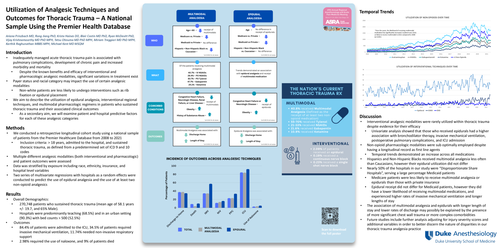
•We conducted a retrospective longitudinal cohort study using a national sample of patients from the Premier Healthcare Database from 2008 to 2021
•Inclusion criteria: > 18 years, admitted to the hospital, and sustained thoracic trauma, as defined from a predetermined set of ICD 9 and 10 codes
•Multiple different analgesic modalities (both interventional and pharmacologic) and patient outcomes were assessed
•Data was stratified by exposure including race, ethnicity, insurance, and hospital level variables
•Two series of multivariate regressions with hospitals as a random effects were conducted to predict the use of epidural analgesia and the use of at least two non-opioid analgesics
Results
•Overall Demographics:
•270,748 patients who sustained thoracic trauma (mean age of 58.1 years +/- 19.7, and 65% Male).
•Hospitals were predominantly teaching (68.5%) and in an urban setting (90.3%) with bed counts > 500 (52.5%)
•Outcomes
•84.4% of patients were admitted to the ICU, 34.5% of patients required invasive mechanical ventilation, 11.74% needed non-invasive respiratory support
•2.98% required the use of naloxone, and 9% of patients died
Discussion
•Interventional analgesic modalities were rarely utilized within thoracic trauma despite evidence for their efficacy
•Univariate analysis showed that those who received epidurals had a higher association with bronchodilator therapy, invasive mechanical ventilation, postoperative pulmonary complications, and ICU admission
•Non-opioid pharmacologic modalities were sub optimally employed despite having a longitudinal record as first line agents
•Temporal trends demonstrated an increase across all medications
•Hispanics and Non-Hispanic Blacks received multimodal analgesia less often than Caucasians, however their epidural utilization did not differ
•Nearly 50% of the hospitals in our study were “Disproportionate Share Hospitals”, serving a large percentage Medicaid patients
•Medicare patients were less likely to receive multimodal analgesia or epidurals than those with private insurance
•Epidural receipt did not differ for Medicaid patients, however they did have a lower likelihood of receiving multimodal medications, and experienced higher rates of invasive mechanical ventilation and longer lengths of stay
•The association of multimodal analgesia and epidurals with longer length of stay and lower rates of discharge may possibly be explained by the presence of more significant chest wall trauma or more complex comorbidities
•Future studies include further analysis adjusting for injury severity scores and additional variables in order to better discern the nature of disparities in our thoracic trauma analgesia practice