457 posters, 2 videos, 2 audios, 8 topics, 45 sessions, 401 authors, 265 institutions
ePostersLive by SciGen Technologies S.A. All rights reserved.
49th Annual Regional Anesthesiology and Acute Pain Medicine Meeting
March 21-23, 2024 | The Hilton Bayfront San Diego | San Diego, California

5528
FIRST RIB RESECTION FOR THORACIC OUTLET SYNDROME: A RETROSPECTIVE ANALYSIS
Poster Presenter
Authors
Affiliations
Part of Topic
Scientific Abstracts > Acute Pain
Introduction
First rib resection is often indicated in patients with Thoracic outlet syndrome (TOS) and can be performed via supraclavicular or trans-axillary approaches. (1)
Surgery is performed near the brachial plexuses and there is hesitancy for regional anesthesia. However, the proximal intercostal block (PICB) is a chest wall block that could be offered as an alternative. The benefit is that it covers incisional pain while allowing for a neurologic exam of the upper extremity.
-In this study, we aim to describe the continuous PICB technique and its evolution, analyze our outcomes, and describe our experience.
-This should also serve as a pilot report to a larger prospective single- or multi-center trial examining the benefits of regional anesthesia/analgesia in patients undergoing first rib resection.
Material and methods
After IRB approval, authors reviewed all cases that underwent supraclavicular first rib resection for thoracic outlet syndrome from 2020 until 2023.
-Data was analyzed and included demographic data, and pain scores on a verbal numerical scale (VNS) from (0-10) during the hospital admission, specifically focusing on opioid requirements during PACU admission, as well as documented analgesics use and pain scores for the first 96 hours.
-Morphine milliequivalents were calculated for hydromorphone and oxycodone through an Opioid conversion calculator from Oregon Pain Guidelines an online tool.
-We excluded patients who underwent a redo first rib resection.
Results
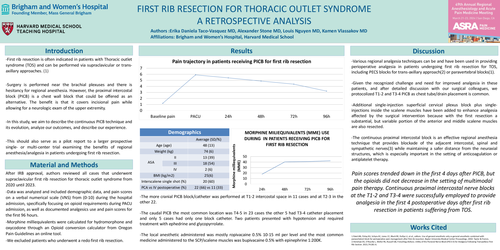
-The more cranial PICB block/catheter was performed at T1-2 intercostal space in 11 cases and at T2-3 in the other 22.
-The caudal PICB the most common location was T4-5 in 23 cases the other 5 had T3-4 catheter placement and only 5 cases had only one block catheter. Two patients presented with hypotension and required treatment with ephedrine and glycopyrrolate.
-The local anesthetic administered was mostly ropivacaine 0.5% 10-15 ml per level and the most common medicine administered to the SCP/scalene muscles was bupivacaine 0.5% with epinephrine 1:200K.
Discussion
-Various regional analgesia techniques can be and have been used in providing perioperative analgesia in patients undergoing first rib resection for TOS, including PECS blocks for trans-axillary approach(2) or paravertebral blocks(1).
-Given the recognized challenge and need for improved analgesia in these patients, and after detailed discussion with our surgical colleagues, we protocolized T1-2 and T3-4 PICB as chest tube/drain placement is common.
-Additional single-injection superficial cervical plexus block plus single-injections inside the scalene muscles have been added to enhance analgesia affected by the surgical intervention because with the first resection a substantial, but variable portion of the anterior and middle scalene muscles are also resected.
-The continuous proximal intercostal block is an effective regional anesthesia technique that provides blockade of the adjacent intercostal, spinal and sympathetic nerves(3) while maintaining a safer distance from the neuraxial structures, which is especially important in the setting of anticoagulation or antiplatelet therapy.
Pain scores trended down in the first 4 days after PICB, but the opioids did not decrease in the setting of multimodal pain therapy. Continuous proximal intercostal nerve blocks at the T1-2 and T3-4 were successfully employed to provide analgesia in the first 4 postoperative days after first rib resection in patients suffering from TOS.
Work listed
1.Patel AN, Finlay KU, Schyra KC, Jones CC, Black RE, Dullye LJ, et al., editors. Use of general anesthetic only vs general anesthetic combined with paravertebral block for perioperative pain management after first rib resection. Baylor University Medical Center Proceedings; 2002: Taylor & Francis.
2.Henshaw DS, O'Rourke L, Weller RS, Russell GB, Freischlag JAJAovs. Utility of the Pectoral Nerve Block (PECS II) for Analgesia Following Transaxillary First Rib Section. 2021;74:281-6.