425 posters, 1 videos, 9 audios, 8 topics, 53 sessions, 340 authors, 286 institutions
ePostersLive by SciGen Technologies S.A. All rights reserved.
22nd Annual Pain Medicine Meeting 2023
November 10 - 11, 2023 | New Orleans Marriott | New Orleans, Louisiana, USA

5029
SPINAL CORD STIMULATOR IN THE PARTURIENT AND ANESTHETIC CONSIDERATION FOR CESEAREAN SECTION
Poster Presenter
Authors
Affiliations
Part of Topic
Education
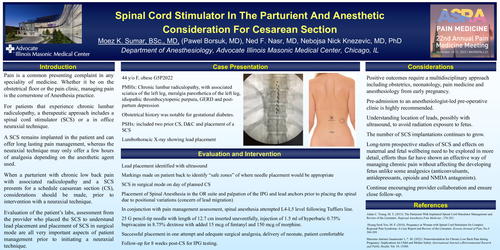
Spinal Cord Stimulator In The Parturient And Anesthetic Consideration For Cesarean Section
Moez K. Sumar, BSc., MD, (Pawel Borsuk, MD), Ned F. Nasr, MD, Nebojsa Nick Knezevic, MD, PhD
Department of Anesthesiology, Advocate Illinois Masonic Medical Center, Chicago, IL
Introduction
Pain is a common presenting complaint in any speciality of medicine. Whether it be on the obstetrical floor or the pain clinic, managing pain is the cornerstone of Anesthesia practice.
For patients that experience chronic lumbar radiculopathy, a therapeutic approach includes a spinal cord stimulator (SCS) or a in office neuraxial technique.
A SCS remains implanted in the patient and can offer long lasting pain management, whereas the neuraxial technique may only offer a few hours of analgesia depending on the anesthetic agent used.
When a parturient with chronic low back pain with associated radiculopathy and a SCS presents for a schedule caesarean section (CS), considerations should be made, prior to intervention with a neuraxial technique.
Evaluation of the patient’s labs, assessment from the provider who placed the SCS to understand lead placement and placement of SCS in surgical mode are all very important aspects of patient management prior to initiating a neuraxial technique.
Case Presentation
44 y/o F, obese G5P2022
PMHx: Chronic lumbar radiculopathy, with associated sciatica of the left leg, meralgia paresthetica of the left leg, idiopathic thrombocytopenic purpura, GERD and post- partum depression
Obstetrical history was notable for gestational diabetes.
PSHx: included two prior CS, D&C and placement of a SCS
Lumbothoracic X-ray showing lead placement
Evaluation and Intervention
Lead placement identified with ultrasound
Markings made on patient back to identify “safe zones” of where needle placement would be appropriate
SCS in surgical mode on day of planned CS
Placement of Spinal Anesthesia in the OR suite and palpation of the IPG and lead anchors prior to placing the spinal due to positional variations (concern of lead migration)
In conjunction with pain management assessment, spinal anesthesia attempted L4-L5 level following Tuffiers line.
25 G pencil-tip needle with length of 12.7 cm inserted uneventfully, injection of 1.5 ml of hyperbaric 0.75% bupivacaine in 8.75% dextrose with added 15 mcg of fentanyl and 150 mcg of morphine.
Successful placement in one attempt and adequate surgical analgesia, delivery of neonate, patient comfortable Follow-up for 8 weeks post-CS for IPG testing.
Considerations
Positive outcomes require a multidisciplinary approach including obstetrics, neonatology, pain medicine and anesthesiology from early pregnancy.
Pre-admission to an anesthesiologist-led pre-operative clinic is highly recommended.
Understanding location of leads, possibly with ultrasound, to avoid radiation exposure to fetus.
The number of SCS implantations continues to grow.
Long-term prospective studies of SCS and effects on maternal and fetal wellbeing need to be explored in more detail, efforts thus far have shown an effective way of managing chronic pain without affecting the developing fetus unlike some analgesics (anticonvulsants, antidepressants, opioids and NMDA antagonists).
Continue encouraging provider collaboration and ensure close follow-up.
References
Adam C. Young, M. T. (2015). The Parturient With Implanted Spinal Cord Stimulator Management and Review of the Literature. Regional Anesthesia Pain Medicine , 276-283.
Hyung Seok Yoo, M. F. (2010). Pregnancy in Woman with Spinal Cord Stimulator for Complex Regional Pain Syndrome: A Case Report and Review of the Literature. Korean Jorunal of Pain, No.4 266-269.
Massimo Antonio Innamorato 1, *. M. (2022). Neurostimulation for Chronic Low Back Pain during Pregnancy: Implications for Child and Mother Safety. International Journal o fEnvironmental Rsearch and Public Health, Vol. 19, 15488.