425 posters, 1 videos, 9 audios, 8 topics, 53 sessions, 340 authors, 286 institutions
ePostersLive by SciGen Technologies S.A. All rights reserved.
22nd Annual Pain Medicine Meeting 2023
November 10 - 11, 2023 | New Orleans Marriott | New Orleans, Louisiana, USA

4658
HOW MRI CONDITIONALITY OF AN SCS SYSTEM COULD IMPEDE SCREENING FOR BREAST CANCER
Poster Presenter
Authors
Affiliations
Part of Topic
Education
How MRI Conditionality of an SCS System Could Impede Screening for Breast Cancer
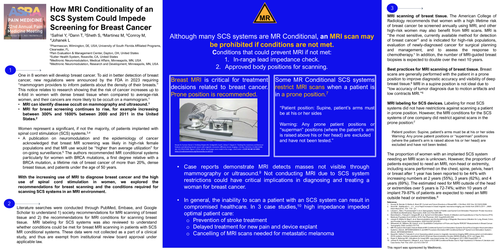
One in 8 women will develop breast cancer. To aid in better detection of breast cancer, new regulations were announced by the FDA in 2023 requiring “mammogram providers to inform patients about the density of their breasts.” This notice relates to research showing that the risk of cancer increases up to 4-fold in women with dense breast tissue when compared to average-risk women, and their cancers are more likely to be occult on a mammogram.1
Women represent a significant, if not the majority, of patients implanted with spinal cord stimulation (SCS) systems.3,4 A publication on neuromodulation and the epidemiology of cancer acknowledged that breast MR screening was likely in high-risk female populations and that MR use would be “higher than average utilization” for on-going surveillance.5 The authors recommended MR conditional systems particularly for women with BRCA mutations, a first degree relative with a BRCA mutation, a lifetime risk of breast cancer of more than 20%, dense breast tissue, and patients under the age of 50 years.
With the increasing use of MRI to diagnose breast cancer and the high use of spinal cord stimulation in women, we explored the recommendations for breast scanning and the conditions required for scanning SCS systems in an MRI environment
Literature searches were conducted through PubMed, Embase, and Google Scholar to understand 1) society recommendations for MRI scanning of breast tissue and 2) the recommendations for MRI conditions for scanning breast tissue. MRI labeling for SCS systems was also reviewed to understand whether conditions could be met for breast MRI scanning in patients with SCS MR conditional systems. These data were not collected as a part of a clinical study, and thus are exempt from institutional review board approval under applicable law.
MRI scanning of breast tissue. The American College of Radiology recommends that women with a high lifetime risk of breast cancer be screened annually using MRI, and other high-risk women may also benefit from MRI scans. MRI is “the most sensitive, currently available method for detection of breast cancer” and is indicated for high-risk populations, evaluation of newly-diagnosed cancer for surgical planning and management, and to assess the response to chemotherapy.1 In addition, the number of MRI-guided breast biopsies is expected to double over the next 10 years.
Best practices for MRI scanning of breast tissue. Breast scans are generally performed with the patient in a prone position to improve diagnostic accuracy and visibility of deep breast tissue.6 MRI in a supine position is not ideal due to “low accuracy of tumor diagnosis due to motion artifacts and low contracts MRI.”6
MRI labeling for SCS devices. Labeling for most SCS systems did not have restrictions against scanning a patient in prone position. However, the MRI conditions for the SCS systems of one company did restrict against scans in the prone position:7
Patient position: Supine, patient’s arms must be at his or her sides
Warning: Any prone patient positions or “superman” positions (where the patient’s arm is raised above his or her head) are excluded and have not been tested.
The proportion of women with an implanted SCS system needing an MRI scan is unknown. However, the proportion of patients expected to need an MRI, non-head or extremity, including scans performed on the chest, spine, pelvis, heart or breast after 1 year has been reported to be 44% with increasing numbers at 2 years (55%), 3 years (62%), and 4 years (69%). The estimated need for MRI outside of the head or extremities over 5 years is 72-74%; within 10 years of implant 79-87% of patients are expected to need an MRI outside head or extremities.8
References