425 posters, 1 videos, 9 audios, 8 topics, 53 sessions, 340 authors, 286 institutions
ePostersLive by SciGen Technologies S.A. All rights reserved.
22nd Annual Pain Medicine Meeting 2023
November 10 - 11, 2023 | New Orleans Marriott | New Orleans, Louisiana, USA

4825
DO DEPLETED SCS SYSTEMS MEET REQUIRED CONDITIONS FOR MRI SCANS?
Poster Presenter
Authors
Affiliations
Part of Topic
Education
Do Depleted SCS Systems Meet Required Conditions for MRI Scans?
Inadequate pain relief or loss of efficacy is the main reason for explant of spinal cord stimulation (SCS) systems. When SCS stops providing pain relief, patients likely abandon use of the therapy, causing the battery to deplete. While some patients have the system explanted, another patient population likely retains, but no longer uses the system. As patients continue to seek treatment for their pain or other health conditions, a depleted SCS system may impede their access to optimal healthcare.
Up to 84% of implanted SCS patients are expected to need an MRI scan within 5 years of implant, with the expectation reaching up to 98% by 10 years.1
There is a high probability that patients who stop using their system and have a depleted battery will need an MRI.
SCS system labeling was reviewed to understand the MRI requirements for conditional systems. Research on features that enable scanning of depleted battery are described.
Impedance requirement for most SCS systems. Once an SCS device is depleted, it can be impossible to perform an impedance check of the system. Nearly all SCS systems require an evaluation of impedances as a condition for MRI scanning. For example, excerpts from labeling warned against performing an MRI procedure on leads with “lead impedance measurements not within the lead impedance limits”,2 “when the impedances are not within the acceptable range”,3 and “if the impedance check on the Remote Control does not pass.”4
Testing and features enabling scanning of depleted systems. Evaluation of impedance was not a requirement for some SCS devices.5 These systems include protective radiofrequency shielding around the lead that dissipates heat. Monte Carlo temperature predictions for 100 million independent simulated scans demonstrated lead temperatures stayed below 43ºC.6 Additional analysis showed that broken lead wires for this lead design result in insignificant electrode temperature increase, and therefore the MR Conditional labeling does not require lead impedance to be verified.
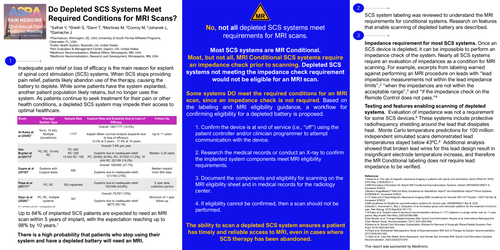
Most SCS systems are MR Conditional. Most, but not all, MRI Conditional SCS systems require an impedance check prior to scanning. Depleted SCS systems not meeting the impedance check requirement would not be eligible for an MRI scan.
Some systems DO meet the required conditions for an MRI scan, since an impedance check is not required. Based on the labeling and MRI eligibility guidance, a workflow for confirming eligibility for a depleted battery is proposed.
The ability to scan a depleted SCS system ensures a patient has timely and reliable access to MRI, even in cases where SCS therapy has been abandoned.
References
1.Desai et al. The rate of magnetic resonance imaging in patients with spinal cord stimulation. Spine (Phila Pa 1976). 2015 May 1;40(9):E531-7.
2.MRI Procedure Information for Abbott MR Conditional Neurostimulation Systems, Abbott; ARTEN600190677 A. Accessed 3/28/23
3.Boston ImageReady™ MRI Full Body Guidelines for WaveWriter Alpha™ and WaveWriter Alpha™ Prime Systems 92395569-01. Accessed 3/28/23
4.1.5 Tesla and 3 Tesla Magnetic Resonance Imaging (MRI) Guidelines for Senza® HFX iQ™ System. 10001162 Rev B. Accessed 3/28/23
5.MRI guidelines for Medtronic neurostimulation systems for chronic pain. M939858A027 Rev B. 2022
6.Davies C, Komoroski C, Roy L. Evaluation of an innovative spinal cord stimulator platform for the treatment of chronic pain. Pain Manag. 2018 May;8(3):167-174.