425 posters, 1 videos, 9 audios, 8 topics, 53 sessions, 340 authors, 286 institutions
ePostersLive by SciGen Technologies S.A. All rights reserved.
22nd Annual Pain Medicine Meeting 2023
November 10 - 11, 2023 | New Orleans Marriott | New Orleans, Louisiana, USA

4899
CASE-BASED CURRICULUM WITH PEER-ASSISTED LEARNING CAN IMPROVE KNOWLEDGE RETENTION IN MULTIDISCIPLINARY PAIN MEDICINE TRAINING.
Poster Presenter
Authors
Affiliations
Part of Topic
Education
TITLE
Case-based curriculum with peer-assisted learning can improve knowledge retention in multidisciplinary pain medicine training
BACKGROUND
Comprehensive information addressing how to best incorporate trainees with diverse prior training in a multidisciplinary subspecialty fellowship is lacking.
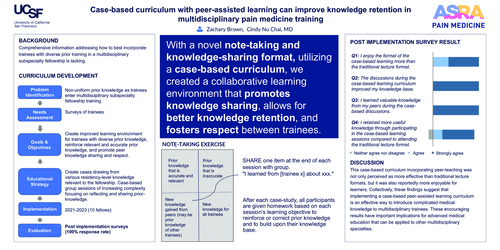
With a novel note-taking and knowledge-sharing format, utilizing a case-based curriculum, we created a collaborative learning environment that promotes knowledge sharing, allows for better knowledge retention, and fosters respect between trainees.
CURRICULUM DEVELOPMENT
Non-uniform prior knowledge as trainees enter multidisciplinary subspecialty fellowship training
Surveys of trainees
Create improved learning environment for trainees with diverse prior knowledge, reinforce relevant and accurate prior knowledge, and promote peer knowledge sharing and respect.
Create cases drawing from
various residency-level knowledge relevant to the fellowship. Case-based group sessions of increasing complexity focusing on reflecting and sharing prior- knowledge.
POST IMPLEMENTATION SURVEY RESULT
Q1: I enjoy the format of the case-based learning more than the traditional lecture format.
Q2: The discussions during the case-based learning curriculum improved my knowledge base.
Q3: I learned valuable knowledge from my peers during the case- based discussions.
Q4: I retained more useful knowledge through participating in the case-based learning sessions compared to attending the traditional lecture format.
RESULTS
This case-based curriculum incorporating peer-teaching was not only perceived as more effective than traditional lecture formats, but it was also reportedly more enjoyable for learners. Collectively, these findings suggest that implementing a case-based peer-assisted learning curriculum is an effective way to introduce complicated medical knowledge to multidisciplinary trainees. These encouraging results have important implications for advanced medical education that can be applied to other multidisciplinary specialties.