136 posters, 2 topics, 27 sessions, 339 authors, 88 institutions
ePostersLive by SciGen Technologies S.A. All rights reserved.
2024 ACP Annual Session
NOVEMBER 6-9, 2024 | MARCO ISLAND, FL JW MARRIOT

94
Fabricate custom occlusal guard using a markerless stereo mandibular jaw tracking
Poster Presenter
Part of Topic
Original Research
Fabricate Custom Occlusal Device Using A Markerless Stereo Mandibular Jaw Tracking
by
Robert Gargano D.D.S., M.S., Prosthodontics resident, Department of Restorative Sciences and Biomaterials, Henry M. Goldman School of Dental Medicine, Boston University, Boston, MA
Junyuan Yang B.E., M.Sc., Graduate student, Rackham Graduate School, University of Michigan, Ann Arbor, MI
Zengyi Qin, B.E., M.Sc., PhD candidate, Institute for Medical Engineering and Science, Massachusetts Institute of Technology, Cambridge, MA
Peixi Liao, B.D.S., D.Sc.D., Clinical Associate Professor, Department of Restorative Sciences and Biomaterials, Henry M. Goldman School of Dental Medicine, Boston University, Boston, MA
Introduction:
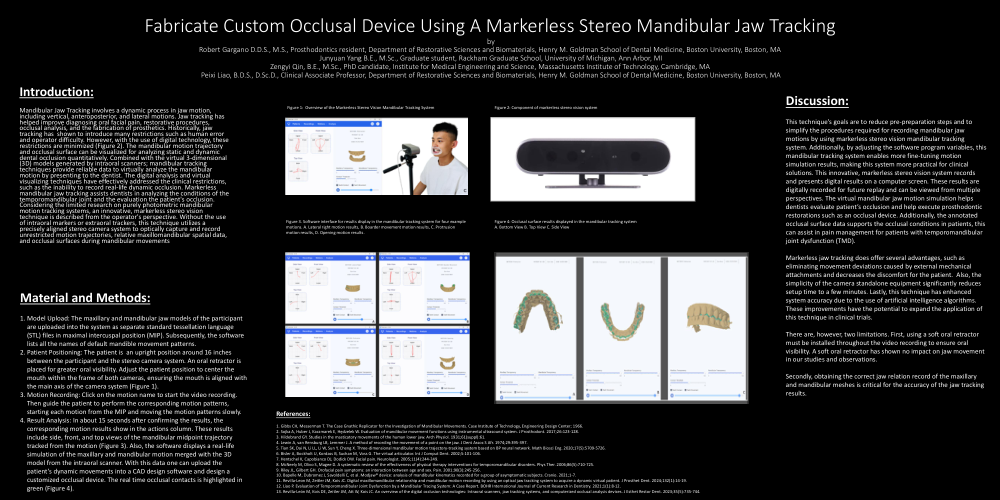
Mandibular Jaw Tracking involves a dynamic process in jaw motion, including vertical, anteroposterior, and lateral motions. Jaw tracking has helped improve diagnosing oral facial pain, restorative procedures, occlusal analysis, and the fabrication of prosthetics. Historically, jaw tracking has shown to introduce many restrictions such as human error and operator difficulty. However, with the use of digital technology, these restrictions are minimized (Figure 2). The mandibular motion trajectory and occlusal surface can be visualized for analyzing static and dynamic dental occlusion quantitatively. Combined with the virtual 3-dimensional (3D) models generated by intraoral scanners; mandibular tracking techniques provide reliable data to virtually analyze the mandibular motion by presenting to the dentist. The digital analysis and virtual visualizing techniques have effectively addressed the clinical restrictions, such as inability to record real-life dynamic occlusion. Mandibular jaw tracking has been widely recognized as a crucial method in assisting the analysis of temporomandibular joint dysfunction (TMD). TMD symptoms can be recorded and measured with a mandibular jaw tracking device. This assists dentists in analyzing the conditions of the temporomandibular joint and the evaluation the patient's occlusion. Considering the limited research on purely photometric mandibular motion tracking systems, an innovative, markerless stereo vision technique is described from the operator's perspective. Without the use of intraoral markers or extraoral trackers, this technique utilizes a precisely aligned stereo camera system to optically capture and record unrestricted motion trajectories, relative maxillomandibular spatial data, and occlusal surfaces during mandibular movements