136 posters, 2 topics, 27 sessions, 339 authors, 88 institutions
ePostersLive by SciGen Technologies S.A. All rights reserved.
2024 ACP Annual Session
NOVEMBER 6-9, 2024 | MARCO ISLAND, FL JW MARRIOT

110
Epithelial Cell Attachment on Titanium surface coated with ZrO2-TiO2 through Atomic Layer Deposition
Poster Presenter
Authors
Affiliations
Part of Topic
Original Research
Abstract
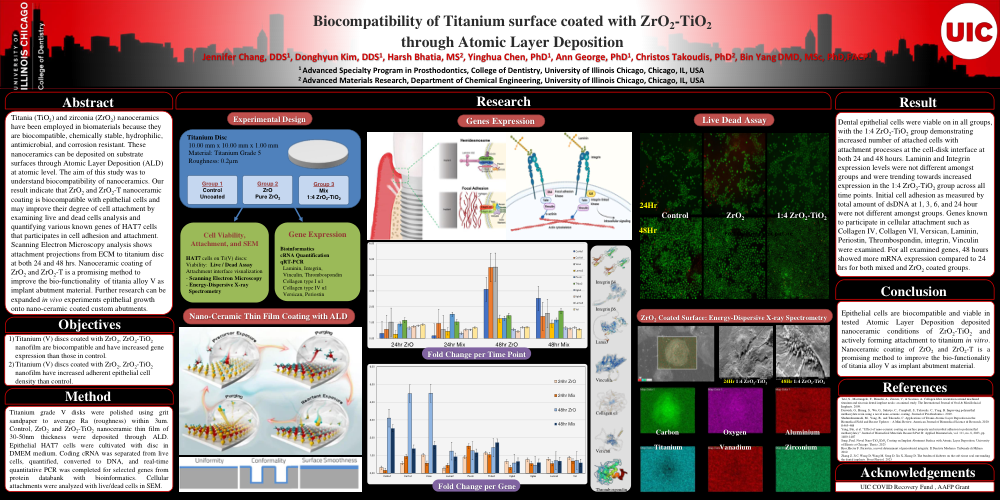
Titania (TiO2) and zirconia (ZrO2) nanoceramics have been employed in various dental industries because they are biocompatible, chemically stable, hydrophilic, antimicrobial, and corrosion resistant. These nanoceramics can be deposited on substrate surfaces through Atomic Layer Deposition (ALD) at one atomic layer at a time, leading to precise control of thickness. Aim of this study was to understand biocompatibility of different nanoceramics and its aid in adhesion and attachment.
We showed in-vitro evidence that the biofunctionalization of titanium surface by means of a nanoceramic coating is biocompatible with epithelial cells, and may improve their degree of attachment by examining live and dead cells analysis and quantifying various known genes of HAT7 cells that participates in cell adhesion and attachment. Scanning Electron Microscopy analysis shows attachment projections from ECM to titanium disc at both 24 and 48 hrs.
Objectives
Method
Titanium grade V disks were polished using grit sandpaper to average Ra (roughness) within 3um. Control, ZrO2 and ZrO2-TiO2 nanoceramic thin film of 30-50nm thickness were deposited through ALD. Epithelial HAT7 cells were cultivated with disc in DMEM medium. Coding cRNA was separated from live cells, quantified, converted to DNA, and real-time quantitative PCR was completed for selected genes. Cellular attachments were analyzed with live/dead cells with SEM.
Result
Dental epithelial cells were viable on in all groups, with the 1:4 ZrO2-TiO2 group demonstrating increased number of attached cells with attachment processes at the cell-disk interface at both 24 and 48 hours. Laminin and Integrin expression levels were not different amongst groups, but were trending towards increased expression in the 1:4 ZrO2-TiO2 group across all time points. Initial cell adhesion as measured by the total amount of dsDNA at 1, 3, 6, and 24 hour was not different amongst groups. Genes known to participate in cellular attachment such as Collagen IV, Collagen VI, Versican, Laminin, Periostin, Thrombospondin, integrin, Vinculin were examined. For all examined genes, 48 hours showed more mRNA expression compared to 24 hrs for both mixed and ZrO2 coated groups.
Conclusion
Epithelial cells are biocompatible and viable in tested Atomic Layer Deposition deposited nanoceramic conditions of ZrO2-TiO2 and actively forming attachment to titanium in vitro. Nanoceramic coating of ZrO2 and ZrO2-T is a promising method to improve the bio-functionality of titania alloy V as implant abutment material.