136 posters, 2 topics, 27 sessions, 339 authors, 88 institutions
ePostersLive by SciGen Technologies S.A. All rights reserved.
2024 ACP Annual Session
NOVEMBER 6-9, 2024 | MARCO ISLAND, FL JW MARRIOT

93
Accuracy of Kinematic Hinge Axis Location: Analog vs. Digital Jaw Motion Capture
Poster Presenter
Authors
Affiliations
Part of Topic
Original Research
Accuracy of Kinematic Hinge Axis Location: Analog vs. Digital Jaw Motion Capture
Maj Song K. Lim, DMD, Resident; Lt Col Aaron B. Harding, DMD, MS, Associate Professor
Prosthodontics Residency, JBSA-Lackland, TX Air Force Postgraduate Dental School, Uniformed Services University of the Health Sciences Postgraduate Dental College
INTRODUCTION
Centric relation (CR) is a stable, reproducible maxillomandibular position where the condyles are positioned anterior-superiorly against the posterior slopes of the articular eminence, independent of tooth contact. This position is essential for reliable reference in prosthodontic procedures, aligning with the patient’s hinge axis. Historically, the kinematic facebow and pantographic methods were used to locate the true hinge axis, but these methods were time-consuming and required technical precision.
Recently, digital advancements have introduced tools like the MODJAW jaw motion tracking system. MODJAW utilizes 3D motion capture to record and analyze mandibular movements in real time, functioning both as a facebow and pantograph. It offers dynamic, patient-specific occlusal data, improving the accuracy of hinge axis determination. By combining motion capture with design software, MODJAW integrates seamlessly into modern CAD/CAM workflows, streamlining prosthodontic processes.
OBJECTIVE AND HYPOTHESIS
This study aimed to assess the accuracy of a digital jaw motion tracking device, MODJAW, in determining the transverse hinge axis in comparison to the traditional analog kinematic facebow and an arbitrary anatomic reference (Schalhorn’s point). The null hypothesis was that there would be no statistically significant difference between the Schalhorn’s Arbitrary Hinge Axis location and the Kinematic Hinge Axis location with the facebow when using the MODJAW hinge axis calculation.
MATERIALS AND METHODS
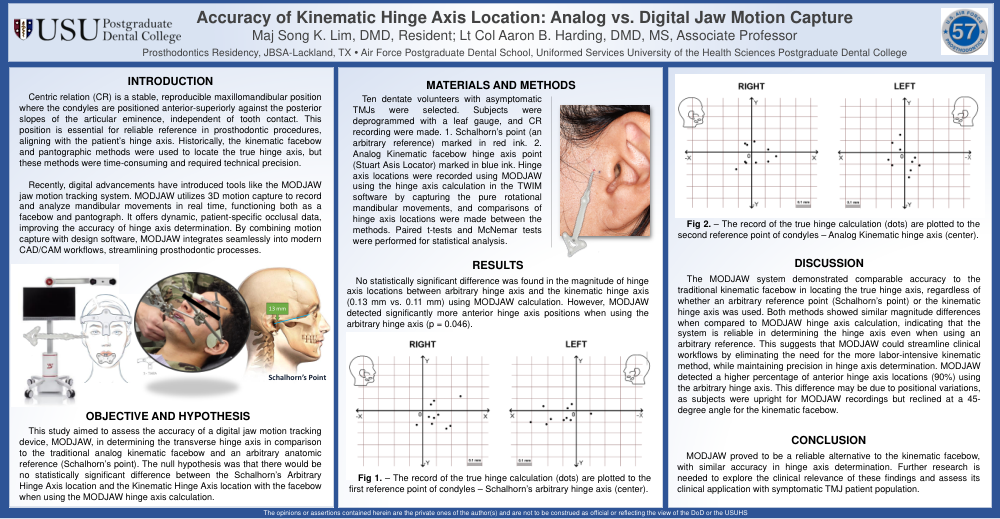
Ten dentate volunteers with asymptomatic TMJs were selected. Subjects were deprogrammed with a leaf gauge, and CR recording were made. 1. Schalhorn’s point (an arbitrary reference) marked in red ink. 2. Analog Kinematic facebow hinge axis point (Stuart Asis Locator) marked in blue ink. Hinge axis locations were recorded using MODJAW using the hinge axis calculation in the TWIM software by capturing the pure rotational mandibular movements, and comparisons of hinge axis locations were made between the methods. Paired t-tests and McNemar tests were performed for statistical analysis.
RESULTS
No statistically significant difference was found in the magnitude of hinge axis locations between arbitrary hinge axis and the kinematic hinge axis (0.13 mm vs. 0.11 mm) using MODJAW calculation. However, MODJAW detected significantly more anterior hinge axis positions when using the arbitrary hinge axis (p = 0.046).
DISCUSSION
The MODJAW system demonstrated comparable accuracy to the traditional kinematic facebow in locating the true hinge axis, regardless of whether an arbitrary reference point (Schalhorn’s point) or the kinematic hinge axis was used. Both methods showed similar magnitude differences when compared to MODJAW hinge axis calculation, indicating that the system is reliable in determining the hinge axis even when using an arbitrary reference. This suggests that MODJAW could streamline clinical workflows by eliminating the need for the more labor-intensive kinematic method, while maintaining precision in hinge axis determination. MODJAW detected a higher percentage of anterior hinge axis locations (90%) using the arbitrary hinge axis. This difference may be due to positional variations, as subjects were upright for MODJAW recordings but reclined at a 45-degree angle for the kinematic facebow.
CONCLUSION
MODJAW proved to be a reliable alternative to the kinematic facebow, with similar accuracy in hinge axis determination. Further research is needed to explore the clinical relevance of these findings and assess its clinical application with symptomatic TMJ patient population.