136 posters, 2 topics, 27 sessions, 339 authors, 88 institutions
ePostersLive by SciGen Technologies S.A. All rights reserved.
2024 ACP Annual Session
NOVEMBER 6-9, 2024 | MARCO ISLAND, FL JW MARRIOT

78
Analyzing ISFPD Creation Methods: Clinical Report
Poster Presenter
Authors
Marissa Gentle, Blake Roney, Tariq Alsahafi, Soni Prasad, Amara Abreu
Affiliations
Part of Topic
Original Research
Analyzing ISFDP Creation Methods: Clinical Report
Marissa Gentle DMD MS, Blake Roney, Tariq Alsahafi BDS MS, Soni Prasad BDS, MS, FACP, MBA,
Amara Abreu DDS, MSD, FACP, University of North Carolina at Chapel Hill
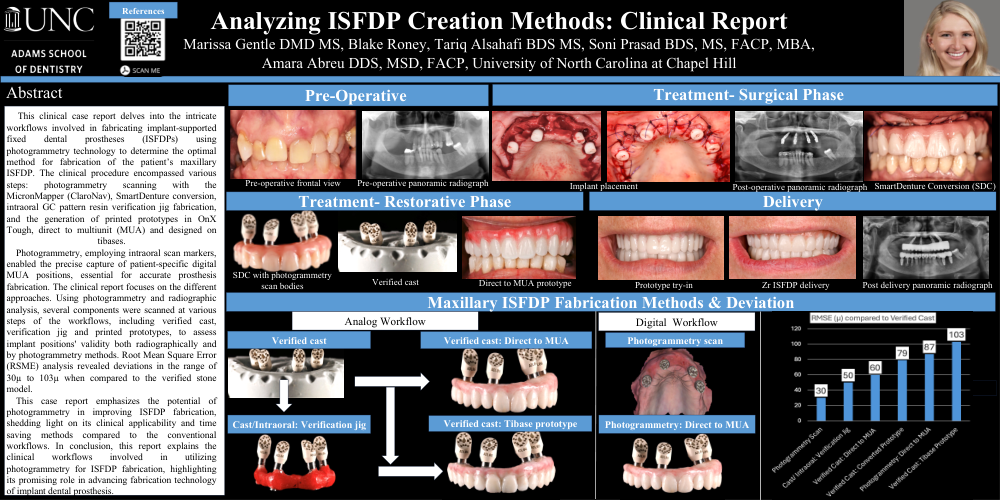
This clinical case report delves into the intricate workflows involved in fabricating implant-supported fixed dental prostheses (ISFDPs) using photogrammetry technology to determine the optimal method for fabrication of the patient’s maxillary ISFDP. The clinical procedure encompassed various steps: photogrammetry scanning with the MicronMapper (ClaroNav), SmartDenture conversion, intraoral GC pattern resin verification jig fabrication, and the generation of printed prototypes in OnX Tough, direct to multiunit (MUA) and designed on tibases.
Photogrammetry, employing intraoral scan markers, enabled the precise capture of patient-specific digital MUA positions, essential for accurate prosthesis fabrication. The clinical report focuses on the different approaches. Using photogrammetry and radiographic analysis, several components were scanned at various steps of the workflows, including verified cast, verification jig and printed prototypes, to assess implant positions' validity both radiographically and by photogrammetry methods. Root Mean Square Error (RSME) analysis revealed deviations in the range of 30µ to 103µ when compared to the verified stone model.
This case report emphasizes the potential of photogrammetry in improving ISFDP fabrication, shedding light on its clinical applicability and time saving methods compared to the conventional workflows. In conclusion, this report explains the clinical workflows involved in utilizing photogrammetry for ISFDP fabrication, highlighting its promising role in advancing fabrication technology of implant dental prosthesis.