136 posters, 2 topics, 27 sessions, 339 authors, 88 institutions
ePostersLive by SciGen Technologies S.A. All rights reserved.
2024 ACP Annual Session
NOVEMBER 6-9, 2024 | MARCO ISLAND, FL JW MARRIOT

60
Impact of scanning patterns and operator experience on the trueness of digital denture duplication using intraoral scanner
Poster Presenter
Authors
Satita Leelaluk, Passent Ellakany, Adam Wade, Hana Eid, Dayna Zaitseva, Leonardo Nassani, Hanin Hammoudeh, Kedith Sawangsri
Affiliations
Part of Topic
Original Research
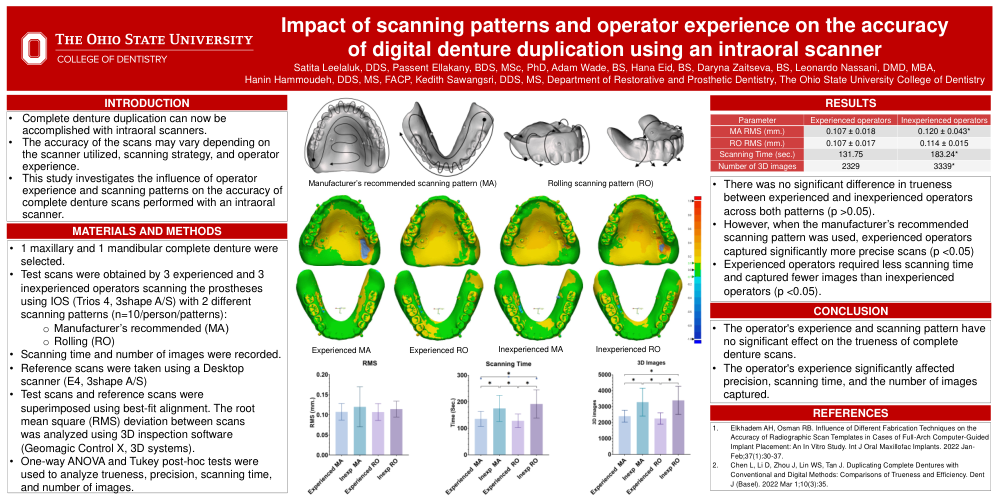
Impact of scanning patterns and operator experience on the accuracy of digital denture duplication using an intraoral scanner
Introduction
•Complete denture duplication can now be accomplished with intraoral scanners.
•The accuracy of the scans may vary depending on the scanner utilized, scanning strategy, and operator experience.
•This study investigates the influence of operator experience and scanning patterns on the accuracy of complete denture scans performed with an intraoral scanner.
Materials and methods
•1 maxillary and 1 mandibular complete denture were selected.
•Test scans were obtained by 3 experienced and 3 inexperienced operators scanning the prostheses using IOS (Trios 4, 3shape A/S) with 2 different scanning patterns (n=10/person/patterns):
o Manufacturer’s recommended (MA)
o Rolling (RO)
•Scanning time and number of images were recorded.
•Reference scans were taken using a Desktop scanner (E4, 3shape A/S)
•Test scans and reference scans were superimposed using best-fit alignment. The root mean square (RMS) deviation between scans was analyzed using 3D inspection software (Geomagic Control X, 3D systems).
•One-way ANOVA and Tukey post-hoc tests were used to analyze trueness, precision, scanning time, and number of images.
Result
•There was no significant difference in trueness between experienced and inexperienced operators across both patterns (p >0.05).
•However, when the manufacturer’s recommended scanning pattern was used, experienced operators captured significantly more precise scans (p <0.05)
•Experienced operators required less scanning time and captured fewer images than inexperienced operators (p <0.05).
Conclusion
•The operator's experience and scanning pattern have no significant effect on the trueness of complete denture scans.
•The operator's experience significantly affected precision, scanning time, and the number of images captured.
References
1. Elkhadem AH, Osman RB. Influence of Different Fabrication Techniques on the Accuracy of Radiographic Scan Templates in Cases of Full-Arch Computer-Guided Implant Placement: An In Vitro Study. Int J Oral Maxillofac Implants. 2022 Jan-Feb;37(1):30-37.
2. Chen L, Li D, Zhou J, Lin WS, Tan J. Duplicating Complete Dentures with Conventional and Digital Methods: Comparisons of Trueness and Efficiency. Dent J (Basel). 2022 Mar 1;10(3):35.