136 posters, 2 topics, 27 sessions, 339 authors, 88 institutions
ePostersLive by SciGen Technologies S.A. All rights reserved.
2024 ACP Annual Session
NOVEMBER 6-9, 2024 | MARCO ISLAND, FL JW MARRIOT

34
Influence of a photosensitizer loading on the physicochemical and antimicrobial properties of a denture resin for additive manufacturing
Poster Presenter
Authors
Amr Farrag, Ricardo Carvalho, Walaa Ahmed, Maria Leite, Adriana Manso
Affiliations
Part of Topic
Original Research
Influence of a photosensitizer loading on the physicochemical and antimicrobial properties of a denture resin for additive manufacturing
Objectives: This research examined the influence of riboflavin, a natural photosensitizer, on physicochemical and antimicrobial properties of a denture base resin used in additive manufacturing.
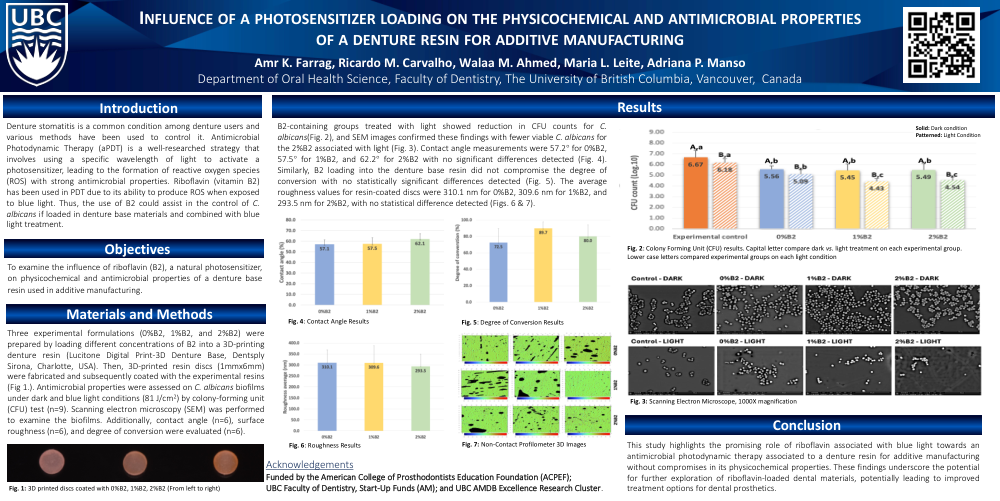
Methods: Three experimental formulations were evaluated by loading different concentrations of B2 into a 3D-printing denture resin (Lucitone Digital Print-3D Denture Base, Dentsply Sirona, Charlotte, USA), groups 0%B2, 1%B2, and 2%B2. 3D-printed resin discs (1mmx6mm) were fabricated with unloaded resin and coated with the experimental resins. Antimicrobial properties were assessed on C. albicans biofilms under dark and blue light conditions (81 J/cm2) by colony-forming unit (CFU) test (n=9). Scanning electron microscopy (SEM) was performed to examine C. albicansmorphology and distribution (n=2). Additionally, contact angle (n=6) and surface roughness (n=6) were assessed. Lastly, the degree of conversion was evaluated by FTIR (n=6).
Results: Groups containing riboflavin showed a marked reduction in CFU counts for C. albicans, especially on the 2%B2 associated with light. Scanning electron microscopy confirmed fewer viable C. albicans on B2-containing resins, being the most significant reduction observed in the 2% B2 associated with blue light. Contact angle measurements were 57.2° for 0%B2, 57.5° for 1%B2, and 62.2° for 2%B2 with no significant differences detected. Similarly, B2 loading into the denture base resin did not compromise the degree of conversion with no statistically significant differences detected. The average roughness values were 310.1 nm for 0%B2-, 309.6 nm for 1%B2-, and 293.5 nm for 2%B2-coated discs, showing no statistical difference between groups.
Conclusion: This study highlights the promising role of riboflavin in enhancing the antimicrobial effects of a denture resin for additive manufacturing without compromises in its physicochemical properties. These findings underscore the potential for further exploration of riboflavin-loaded dental materials, potentially leading to improved treatment options for dental prosthetics.