136 posters, 2 topics, 27 sessions, 339 authors, 88 institutions
ePostersLive by SciGen Technologies S.A. All rights reserved.
2024 ACP Annual Session
NOVEMBER 6-9, 2024 | MARCO ISLAND, FL JW MARRIOT

182
Impact of a Bone Leveler on Prosthetic Abutment Fit in Subcrestal Implant Placement in Guided Implant Surgery
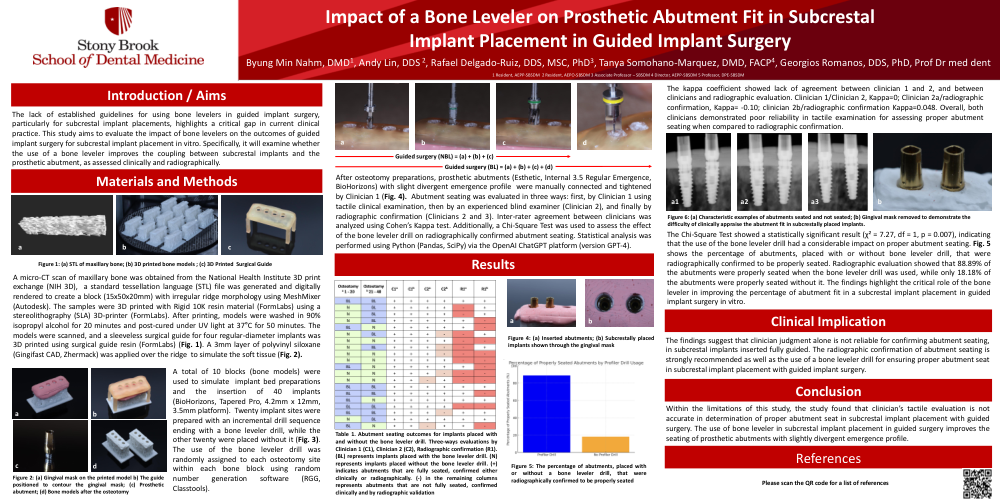
Poster Presenter
Authors
Byung Min Nahm, Andy Lin, Rafael Delgado-Ruiz, Tanya Somohano-Marquez, Georgios Romanos
Affiliations
Part of Topic
Original Research
Impact of a Bone Leveler on Prosthetic Abutment Fit in Subcrestal Implant Placement in Guided Implant Surgery
Introduction
The lack of established guidelines for using bone levelers in guided implant surgery, particularly for subcrestal implant placements, highlights a critical gap in current clinical practice. This study aims to evaluate the impact of bone levelers on the outcomes of guided implant surgery for subcrestal implant placement in vitro. Specifically, it will examine whether the use of a bone leveler improves the coupling between subcrestal implants and the prosthetic abutment, as assessed clinically and radiographically.
Materials/Methods
A micro-CT scan of maxillary bone was obtained from the National Health Institute 3D print exchange (NIH 3D), a standard tessellation language (STL) file was generated and digitally rendered to create a block (15x50x20mm) with irregular ridge morphology using MeshMixer (Autodesk). The samples were 3D printed with Rigid 10K resin material (FormLabs) using a stereolithography (SLA) 3D-printer (FormLabs). After printing, models were washed in 90% isopropyl alcohol for 20 minutes and post-cured under UV light at 37°C for 50 minutes. The models were scanned, and a sleeveless surgical guide for four regular-diameter implants was 3D printed using surgical guide resin (FormLabs) (Fig. 1). A 3mm layer of polyvinyl siloxane (Gingifast CAD, Zhermack) was applied over the ridge to simulate the soft tissue (Fig. 2).
A total of 10 blocks (bone models) were used to simulate implant bed preparations and the insertion of 40 implants (BioHorizons, Tapered Pro, 4.2mm x 12mm, 3.5mm platform). Twenty implant sites were prepared with an incremental drill sequence ending with a bone leveler drill, while the other twenty were placed without it (Fig. 3). The use of the bone leveler drill was randomly assigned to each osteotomy site within each bone block using random number generation software (RGG, Classtools).
After osteotomy preparations, prosthetic abutments (Esthetic, Internal 3.5 Regular Emergence, BioHorizons) with slight divergent emergence profile were manually connected and tightened by Clinician 1 (Fig. 4). Abutment seating was evaluated in three ways: first, by Clinician 1 using tactile clinical examination, then by an experienced blind examiner (Clinician 2), and finally by radiographic confirmation (Clinicians 2 and 3). Inter-rater agreement between clinicians was analyzed using Cohen’s Kappa test. Additionally, a Chi-Square Test was used to assess the effect of the bone leveler drill on radiographically confirmed abutment seating. Statistical analysis was performed using Python (Pandas, SciPy) via the OpenAI ChatGPT platform (version GPT-4).
Results
The kappa coefficient showed lack of agreement between clinician 1 and 2, and between clinicians and radiographic evaluation. Clinician 1/Clinician 2, Kappa=0; Clinician 2a/radiographic confirmation, Kappa= -0.10; clinician 2b/radiographic confirmation Kappa=0.048. Overall, both clinicians demonstrated poor reliability in tactile examination for assessing proper abutment seating when compared to radiographic confirmation.
The Chi-Square Test showed a statistically significant result (χ² = 7.27, df = 1, p = 0.007), indicating that the use of the bone leveler drill had a considerable impact on proper abutment seating. Fig. 5 shows the percentage of abutments, placed with or without bone leveler drill, that were radiographically confirmed to be properly seated. Radiographic evaluation showed that 88.89% of the abutments were properly seated when the bone leveler drill was used, while only 18.18% of the abutments were properly seated without it. The findings highlight the critical role of the bone leveler in improving the percentage of abutment fit in a subcrestal implant placement in guided implant surgery in vitro.
Clinical Implication
The findings suggest that clinician judgment alone is not reliable for confirming abutment seating, in subcrestal implants inserted fully guided. The radiographic confirmation of abutment seating is strongly recommended as well as the use of a bone leveler drill for ensuring proper abutment seat in subcrestal implant placement with guided implant surgery.
Conclusion
Within the limitations of this study, the study found that clinician’s tactile evaluation is not accurate in determination of proper abutment seat in subcrestal implant placement with guided surgery. The use of bone leveler in subcrestal implant placement in guided surgery improves the seating of prosthetic abutments with slightly divergent emergence profile.