136 posters, 2 topics, 27 sessions, 339 authors, 88 institutions
ePostersLive by SciGen Technologies S.A. All rights reserved.
2024 ACP Annual Session
NOVEMBER 6-9, 2024 | MARCO ISLAND, FL JW MARRIOT

176
Surface Integrity of Dental Ceramics Post Resin-Cement Removal by Burning Technique
Poster Presenter
Part of Topic
Original Research
Surface Integrity of Dental Ceramics Post Resin-Cement Removal by Burning Technique
Bruna Vallerini, Natalie Pesun, Igor Pesun, Rodrigo França
University of Manitoba, Department of Restorative Dentistry, Winnipeg, Canada
INTRODUCTION
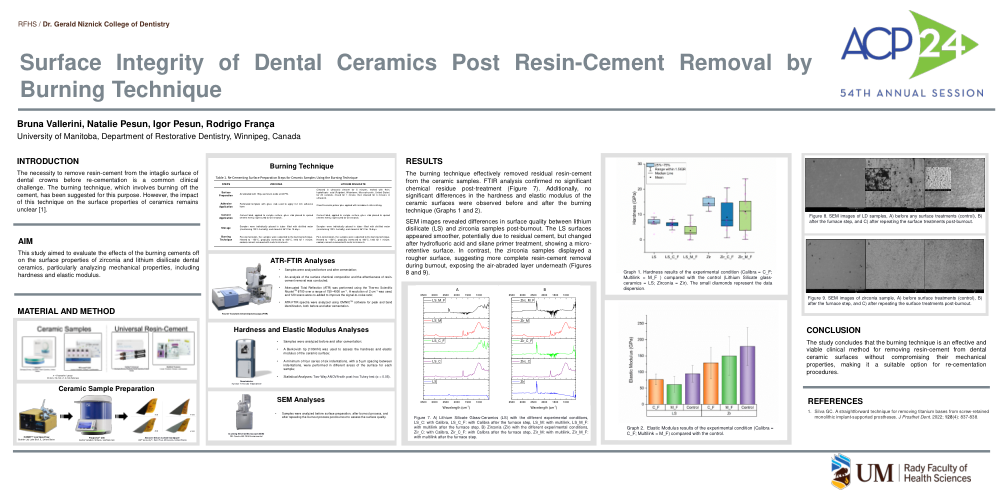
The necessity to remove resin-cement from the intaglio surface of dental crowns before re-cementation is a common clinical challenge. The burning technique, which involves burning off the cement, has been suggested for this purpose. However, the impact of this technique on the surface properties of ceramics remains unclear [1].
AIM
This study aimed to evaluate the effects of the burning cements off on the surface properties of zirconia and lithium disilicate dental ceramics, particularly analyzing mechanical properties, including hardness and elastic modulus.
MATERIAL AND METHOD
RESULTS
The burning technique effectively removed residual resin-cement from the ceramic samples. FTIR analysis confirmed no significant chemical residue post-treatment (Figure 7). Additionally, no significant differences in the hardness and elastic modulus of the ceramic surfaces were observed before and after the burning technique (Graphs 1 and 2).
SEM images revealed differences in surface quality between lithium disilicate (LS) and zirconia samples post-burnout. The LS surfaces appeared smoother, potentially due to residual cement, but changed after hydrofluoric acid and silane primer treatment, showing a micro-retentive surface. In contrast, the zirconia samples displayed a rougher surface, suggesting more complete resin-cement removal during burnout, exposing the air-abraded layer underneath (Figures 8 and 9).
CONCLUSION
The study concludes that the burning technique is an effective and viable clinical method for removing resin-cement from dental ceramic surfaces without compromising their mechanical properties, making it a suitable option for re-cementation procedures.
REFERENCES