136 posters, 2 topics, 27 sessions, 339 authors, 88 institutions
ePostersLive by SciGen Technologies S.A. All rights reserved.
2024 ACP Annual Session
NOVEMBER 6-9, 2024 | MARCO ISLAND, FL JW MARRIOT

175
Assessing the Accuracy of Various Abutment-level Impression Techniques: A Comparative Study Using a Standardized Metal Suprastructure for Verification.
Poster Presenter
Part of Topic
Original Research
Assessing the Accuracy of Various Abutment-level Impression Techniques: Comparative Study Using a Standardized Metal Supra-structure for Verification
Prosthodontics Department, Louisiana State University School of Dentistry, New Orleans, LA
Eddie Perez, DDS , Alejandro Treviño, DDS, MSc
I N T R O D U C T I O N
In implant-supported prosthetics, accurate abutment-level impressions are crucial for the long-term fit and success of restorations. Marginal discrepancies between the prosthetic framework and abutments can cause mechanical issues such as screw loosening & prosthesis misfit, along with biological complications to the implant(s). While various impression techniques have been developed, the most reliable method for minimizing discrepancies is still under investigation. This study compares the accuracy of five impression techniques, using a standardized metal framework to assess marginal fit in multi-unit restorations. By measuring discrepancies between the framework & abutments, the goal is to identify the technique that produces the least amount of error, offering valuable clinical insights.
M A T E R I A L S & M E T H O D S
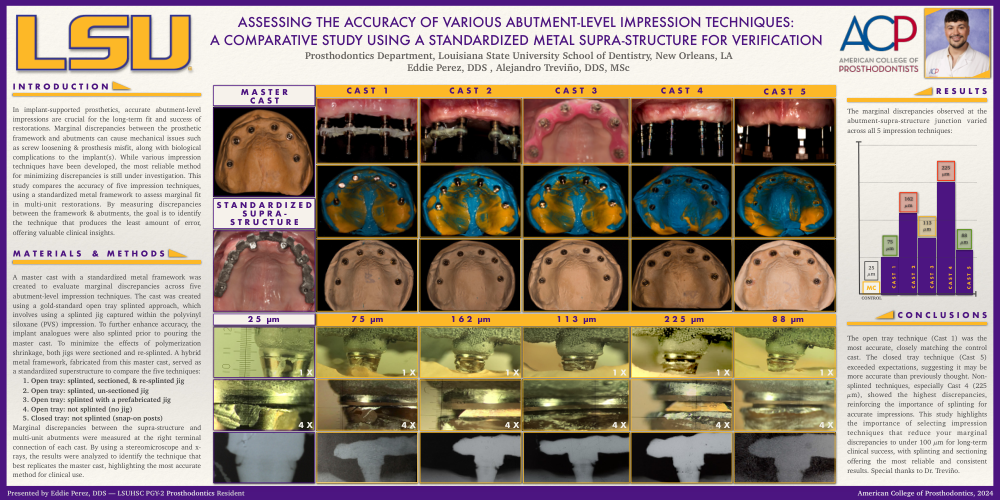
A master cast with a standardized metal framework was created to evaluate marginal discrepancies across five abutment-level impression techniques. The cast was created using a gold-standard open tray splinted approach, which involves using a splinted jig captured within the polyvinyl siloxane (PVS) impression. To further enhance accuracy, the implant analogues were also splinted prior to pouring the master cast. To minimize the effects of polymerization shrinkage, both jigs were sectioned and re-splinted. A hybrid metal framework, fabricated from this master cast, served as a standardized superstructure to compare the five techniques:
1. Open tray: splinted, sectioned, & re-splinted jig
2. Open tray: splinted, un-sectioned jig
3. Open tray: splinted with a prefabricated jig
4. Open tray: not splinted (no jig)
5. Closed tray: not splinted (snap-on posts)
Marginal discrepancies between the supra-structure and multi-unit abutments were measured at the right terminal connection of each cast. By using a stereomicroscope and x-rays, the results were analyzed to identify the technique that best replicates the master cast, highlighting the most accurate method for clinical use.
R E S U L T S
The marginal discrepancies observed at the abutment-supra-structure junction varied across all 5 impression techniques:
[RESULTS TABLE]
C O N C L U S I O N S
The open tray technique (Cast 1) was the most accurate, closely matching the control cast. The closed tray technique (Cast 5) exceeded expectations, suggesting it may be more accurate than previously thought. Non-splinted techniques, especially Cast 4 (225 µm), showed the highest discrepancies, reinforcing the importance of splinting for accurate impressions. This study highlights the importance of selecting impression techniques that reduce your marginal discrepancies to under 100 µm for long-term clinical success, with splinting and sectioning offering the most reliable and consistent results. Special thanks to Dr. Treviño.