136 posters, 2 topics, 27 sessions, 339 authors, 88 institutions
ePostersLive by SciGen Technologies S.A. All rights reserved.
2024 ACP Annual Session
NOVEMBER 6-9, 2024 | MARCO ISLAND, FL JW MARRIOT

17
Screw-Retained Surgical Guide Technique for Implant Placement in Patients with Existing Implants Using Temporary Cylinders
Poster Presenter
Authors
Affiliations
Part of Topic
Original Research
Introduction
One innovative approach to implant placement in patients with existing implants is the use of screw-retained surgical guides combined with temporary cylinders. The purpose of this poster is to present the screw-retained surgical guide technique using temporary cylinders for precise implant placement in patients with pre-existing implants.
Materials&Methods
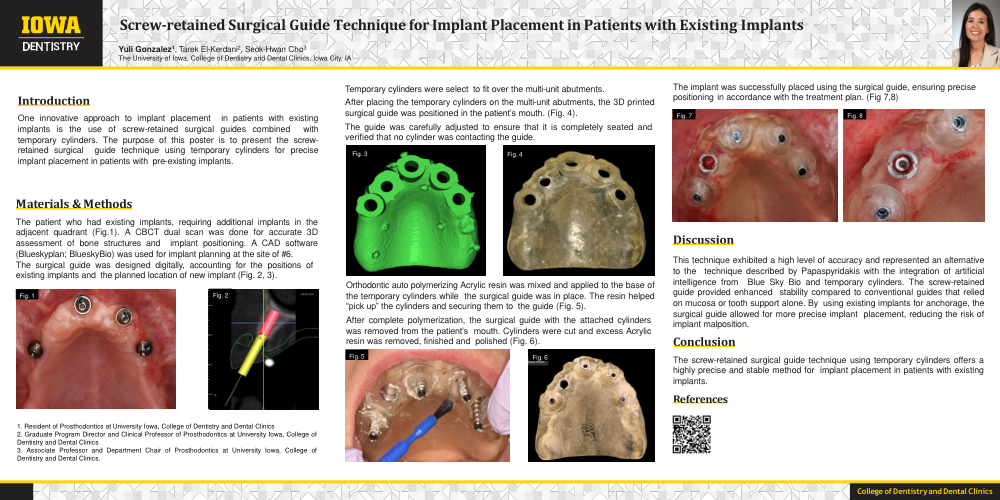
The patient who had existing implants, requiring additional implants in the adjacent quadrant (Fig.1). A CBCT dual scan was done for accurate 3D assessment of bone structures and implant positioning. A CAD software (Blueskyplan; BlueskyBio) was used for implant planning at the site of #6.
The surgical guide was designed digitally, accounting for the positions of existing implants and the planned location of new implant (Fig. 2, 3).
Temporary cylinders were select to fit over the multi-unit abutments.
After placing the temporary cylinders on the multi-unit abutments, the 3D printed surgical guide was positioned in the patient’s mouth. (Fig. 4).
The guide was carefully adjusted to ensure that it is completely seated and verified that no cylinder was contacting the guide.
Orthodontic auto polymerizing Acrylic resin was mixed and applied to the base of the temporary cylinders while the surgical guide was in place. The resin helped “pick up” the cylinders and securing them to the guide (Fig. 5).
After complete polymerization, the surgical guide with the attached cylinders was removed from the patient’s mouth. Cylinders were cut and excess Acrylic resin was removed, finished and polished (Fig. 6).
The implant was successfully placed using the surgical guide, ensuring precise positioning in accordance with the treatment plan. (Fig 7,8)
Discussion
This technique exhibited a high level of accuracy and represented an alternative to the technique described by Papaspyridakis with the integration of artificial intelligence from Blue Sky Bio and temporary cylinders. The screw-retained guide provided enhanced stability compared to conventional guides that relied on mucosa or tooth support alone. By using existing implants for anchorage, the surgical guide allowed for more precise implant placement, reducing the risk of implant malposition.
Conclusion
The screw-retained surgical guide technique using temporary cylinders offers a highly precise and stable method for implant placement in patients with existing implants.