136 posters, 2 topics, 27 sessions, 339 authors, 88 institutions
ePostersLive by SciGen Technologies S.A. All rights reserved.
2024 ACP Annual Session
NOVEMBER 6-9, 2024 | MARCO ISLAND, FL JW MARRIOT

168
Managing screw fracture/screw loosening in a single-unit implant restoration: a retrospective study.
Poster Presenter
Authors
Affiliations
Part of Topic
Original Research
TITLE:
Managing screw loosening in single-unit implant restorations: a retrospective study
Authors:
Marina Youssef, DMD
Allison Broyles, DMD, MS
Despoina Bompolaki, DDS, MS, FACP
Affiliation:
Oregon Health & Science University
Introduction:
Screw loosening or fracture is a common complication with implant-supported restorations and occurs when occlusal forces exceed the screw's axial preload. There is insufficient evidence regarding the optimal management method for screw loosening: retightening the existing screw versus replacing the loose screw with a new one. The purpose of this study was to determine whether screw replacement or screw retightening is equally effective in addressing screw loosening for single-unit implant-supported restorations.
Objectives:
Methodology:
Patients who had a single-unit implant-supported restoration completed at the predoctoral clinic were identified. A word search was performed to identify patients who experienced screw loosening after the delivery of their restoration. Data collected included implant manufacturer, initial torque, method of addressing the loose screw, and subsequent screw loosening events or other complications following the first screw loosening incident. The data were analyzed using statistical analysis software (SPSS v29).
Results/Findings:
Sixty-one patients (33 males, 28 females) with 76 implants (32 Straumann, 32 Zimmer, 7 Nobel, 2 Astra, 2 unspecified) were included in the study. Fixed opposing dentition was present in 95.08% of cases, and the correct initial torque was used in 50.82% of cases. Screw retightening and replacement were performed equally to address screw loosening (n=38 or 50% for each method). No difference was observed in the outcomes of the two methods (x2=.271, p = .602).
Analysis:
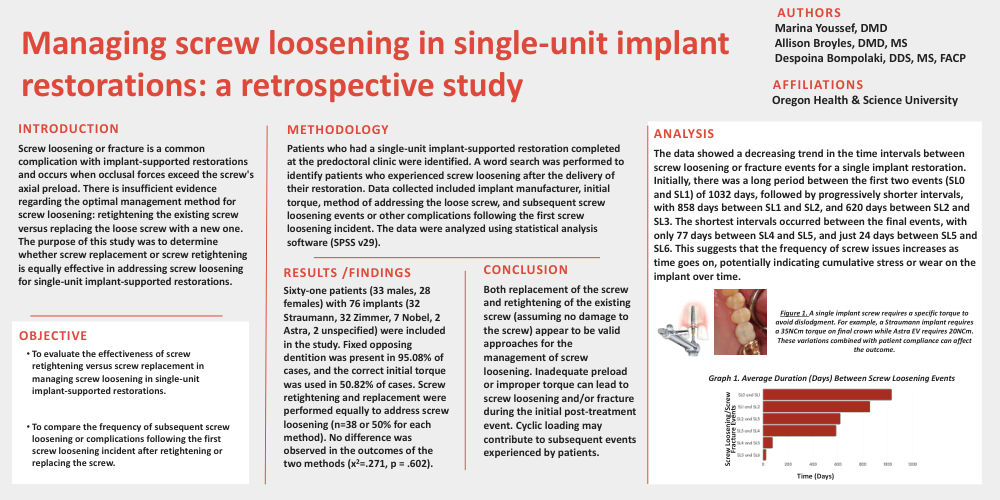
The data showed a decreasing trend in the time intervals between screw loosening or fracture events for a single implant restoration. Initially, there was a long period between the first two events (SL0 and SL1) of 1032 days, followed by progressively shorter intervals, with 858 days between SL1 and SL2, and 620 days between SL2 and SL3. The shortest intervals occurred between the final events, with only 77 days between SL4 and SL5, and just 24 days between SL5 and SL6. This suggests that the frequency of screw issues increases as time goes on, potentially indicating cumulative stress or wear on the implant over time.
Conclusion:
Both replacement of the screw and retightening of the existing screw (assuming no damage to the screw) appear to be valid approaches for the management of screw loosening. Inadequate preload or improper torque can lead to screw loosening and/or fracture during the initial post-treatment event. Cyclic loading may contribute to subsequent events experienced by patients.