136 posters, 2 topics, 27 sessions, 339 authors, 88 institutions
ePostersLive by SciGen Technologies S.A. All rights reserved.
2024 ACP Annual Session
NOVEMBER 6-9, 2024 | MARCO ISLAND, FL JW MARRIOT

160
National Veterans Administration Implant Risk Assessment and Setting Patient Expectations
Poster Presenter
Authors
Affiliations
Part of Topic
Original Research
National Veterans Health Administration Implant Risk Assessment and Patient Education
Patients often believe that implants will solve all of their tooth related problems.(3) This creates a need to increase patient education on potential sequalae of implant placement and improve treatment planning decision making. The use of a dental implant risk assessment with the patient in the early treatment planning stage is the key to establishing the patient’s expectations of this procedure. The Veterans Health Administration (VHA), Office of Dentistry has constructed a risk assessment with clinical recommendations that are based on evidence, when available, and expert consensus, when evidence is not definitive to help improve patient expectations and treatment planning guidelines.(1)(2)(4)
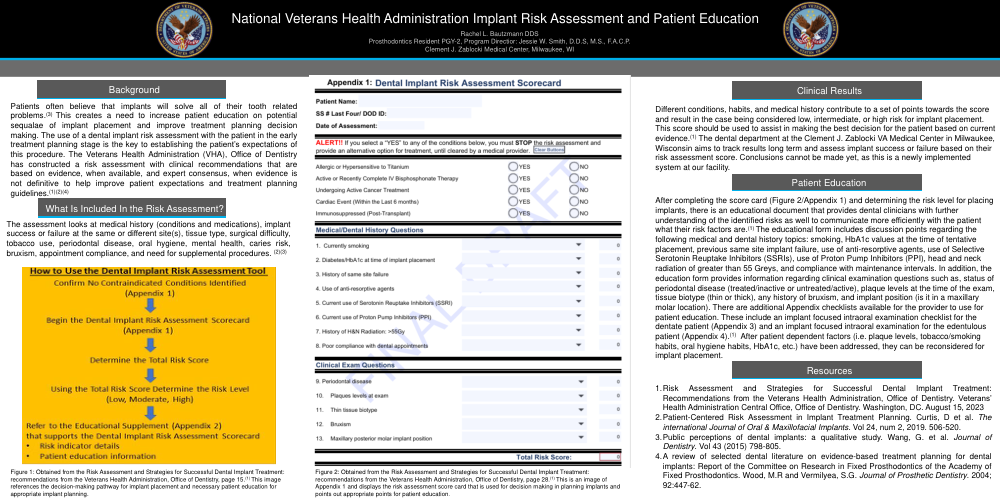
The assessment looks at medical history (conditions and medications), implant success or failure at the same or different site(s), tissue type, surgical difficulty, tobacco use, periodontal disease, oral hygiene, mental health, caries risk, bruxism, appointment compliance, and need for supplemental procedures. (2)(3)
Different conditions, habits, and medical history contribute to a set of points towards the score and result in the case being considered low, intermediate, or high risk for implant placement. This score should be used to assist in making the best decision for the patient based on current evidence.(1) The dental department at the Clement J. Zablocki VA Medical Center in Milwaukee, Wisconsin aims to track results long term and assess implant success or failure based on their risk assessment score. Conclusions cannot be made yet, as this is a newly implemented system at our facility.
After completing the score card (Figure 2/Appendix 1) and determining the risk level for placing implants, there is an educational document that provides dental clinicians with further understanding of the identified risks as well to communicate more efficiently with the patient what their risk factors are.(1) The educational form includes discussion points regarding the following medical and dental history topics: smoking, HbA1c values at the time of tentative placement, previous same site implant failure, use of anti-resorptive agents, use of Selective Serotonin Reuptake Inhibitors (SSRIs), use of Proton Pump Inhibitors (PPI), head and neck radiation of greater than 55 Greys, and compliance with maintenance intervals. In addition, the education form provides information regarding clinical examination questions such as, status of periodontal disease (treated/inactive or untreated/active), plaque levels at the time of the exam, tissue biotype (thin or thick), any history of bruxism, and implant position (is it in a maxillary molar location). There are additional Appendix checklists available for the provider to use for patient education. These include an implant focused intraoral examination checklist for the dentate patient (Appendix 3) and an implant focused intraoral examination for the edentulous patient (Appendix 4).(1) After patient dependent factors (i.e. plaque levels, tobacco/smoking habits, oral hygiene habits, HbA1c, etc.) have been addressed, they can be reconsidered for implant placement.