136 posters, 2 topics, 27 sessions, 339 authors, 88 institutions
ePostersLive by SciGen Technologies S.A. All rights reserved.
2024 ACP Annual Session
NOVEMBER 6-9, 2024 | MARCO ISLAND, FL JW MARRIOT

155
Accuracy of Three Intraoral Scanners in Shade Matching
Poster Presenter
Authors
Maria Aglaia Soundia , Mohammed Akl, Fengyuan Zheng, Alvin Wee
Affiliations
Part of Topic
Original Research
Accuracy of Three Intraoral Scanners In Shade Matching
Objectives: The purpose of this study is to evaluate the trueness and precision of 3 intraoral scanners in shade matching .
Introduction: Accurate replication of tooth shade is an important factor in the success of esthetic restorative dentistry. However, the complex, polychromatic nature of teeth may make the shade replication a challenging process for clinicians. Various instruments for shade matching have been introduced to dentistry to overcome the risk factors associated with shade matching. However, few studies have investigated the applicability of intraoral scanners in shade selection.
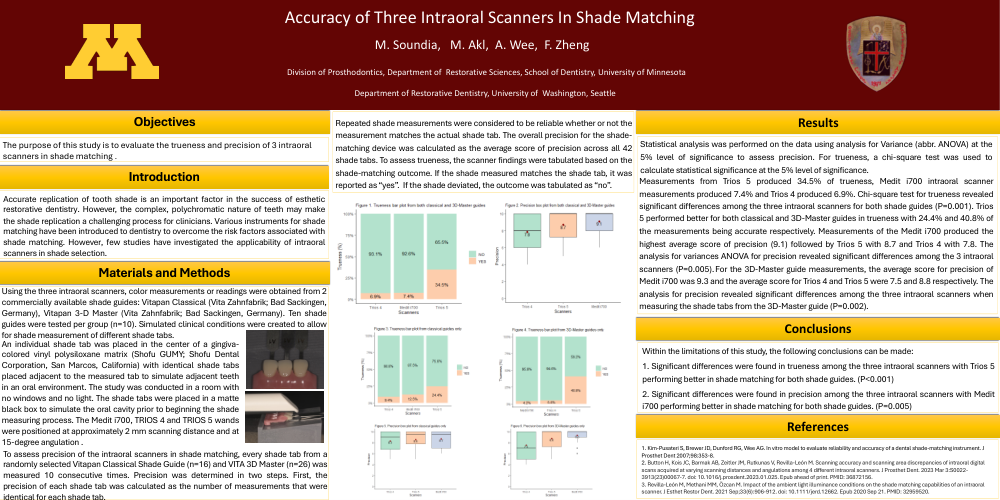
Materials and Methods: Using the three intraoral scanners, color measurements or readings were obtained from 2 commercially available shade guides: Vitapan Classical (Vita Zahnfabrik; Bad Sackingen, Germany), Vitapan 3-D Master (Vita Zahnfabrik; Bad Sackingen, Germany). Ten shade guides were tested per group (n=10). Simulated clinical conditions were created to allow for shade measurement of different shade tabs. An individual shade tab was placed in the center of a gingiva-colored vinyl polysiloxane matrix (Shofu GUMY; Shofu Dental Corporation, San Marcos, California) with identical shade tabs placed adjacent to the measured tab to simulate adjacent teeth in an oral environment. The study was conducted in a room with no windows and no light. The shade tabs were placed in a matte black box to simulate the oral cavity prior to beginning the shade measuring process. The Medit i700, TRIOS 4 and TRIOS 5 wands were positioned at approximately 2 mm scanning distance and at 15-degree angulation.To assess precision of the intraoral scanners in shade matching, every shade tab from a randomly selected Vitapan Classical Shade Guide (n=16) and VITA 3D Master (n=26) was measured 10 consecutive times. Precision was determined in two steps. First, the precision of each shade tab was calculated as the number of measurements that were identical for each shade tab. Repeated shade measurements were considered to be reliable whether or not the measurement matches the actual shade tab. The overall precision for the shade-matching device was calculated as the average score of precision across all 42 shade tabs. To assess trueness, the scanner findings were tabulated based on the shade-matching outcome. If the shade measured matches the shade tab, it was reported as “yes”. If the shade deviated, the outcome was tabulated as “no”.
Results: Statistical analysis was performed on the data using analysis for Variance (abbr. ANOVA) at the 5% level of significance to assess precision. For trueness, a chi-square test was used to calculate statistical significance at the 5% level of significance. Measurements from Trios 5 produced 34.5% of trueness, Medit i700 intraoral scanner measurements produced 7.4% and Trios 4 produced 6.9%. Chi-square test for trueness revealed significant differences among the three intraoral scanners for both shade guides (P=0.001). Trios 5 performed better for both classical and 3D-Master guides in trueness with 24.4% and 40.8% of the measurements being accurate respectively. Measurements of the Medit i700 produced the highest average score of precision (9.1) followed by Trios 5 with 8.7 and Trios 4 with 7.8. The analysis for variances ANOVA for precision revealed significant differences among the 3 intraoral scanners (P=0.005). For the 3D-Master guide measurements, the average score for precision of Medit i700 was 9.3 and the average score for Trios 4 and Trios 5 were 7.5 and 8.8 respectively. The analysis for precision revealed significant differences among the three intraoral scanners when measuring the shade tabs from the 3D-Master guide (P=0.002).
Conclusions:
Within the limitations of this study, the following conclusions can be made:
1. Significant differences were found in trueness among the three intraoral scanners with Trios 5 performing better in shade matching for both shade guides. (P<0.001)
2. Significant differences were found in precision among the three intraoral scanners with Medit i700 performing better in shade matching for both shade guides. (P=0.005)