136 posters, 2 topics, 27 sessions, 339 authors, 88 institutions
ePostersLive by SciGen Technologies S.A. All rights reserved.
2024 ACP Annual Session
NOVEMBER 6-9, 2024 | MARCO ISLAND, FL JW MARRIOT

154
Comparison of Color Properties and Fracture Load of High-Translucency Zirconia with Varied Thickness of Zirconia and Layered Porcelain
Poster Presenter
Authors
Affiliations
Part of Topic
Original Research
Comparison of Color and Physical Properties of High-Translucency Zirconia
with Varied Thickness of Zirconia and Layered Porcelain
Carmen Espinal DDS, Edmara TP Bergamo DDS MS PhD, Lukasz Witek Msci PhD, Thomas Giugliano DDS, Mijin Choi DDS MS MBA FACP
Jonathan and Maxine Ferencz Advanced Education Program in Prosthodontics New York University College of Dentistry
Introduction
High-translucency zirconia (HTZ) has emerged as a prominent choice for dental restorations due to its superior mechanical properties and improved esthetics compared to traditional zirconia.1 The high translucency of zirconia results from the increased concentration of yttria, which has been shown to affect the mechanical and esthetic properties of the restoration directly.2,3 However, the full potential of HTZ can be influenced by various factors, including its thickness and the application of layered porcelain (LP).
The balance between translucency for a natural appearance and fracture resistance for durability is particularly crucial to predictably fabricate restorations without perceptible color mismatches.4,5 The study's null hypothesis is that there are no differences in shades and flexural strength with varied thicknesses of HTZ and LP.
The results of this comparison will offer valuable insights for clinicians and material scientists striving to enhance the performance and esthetic outcomes of dental restorations.
Objectives
This study aims to assess the color properties and flexural strength of varying thicknesses of HTZ restorations with varying thicknesses of LP.
Methods
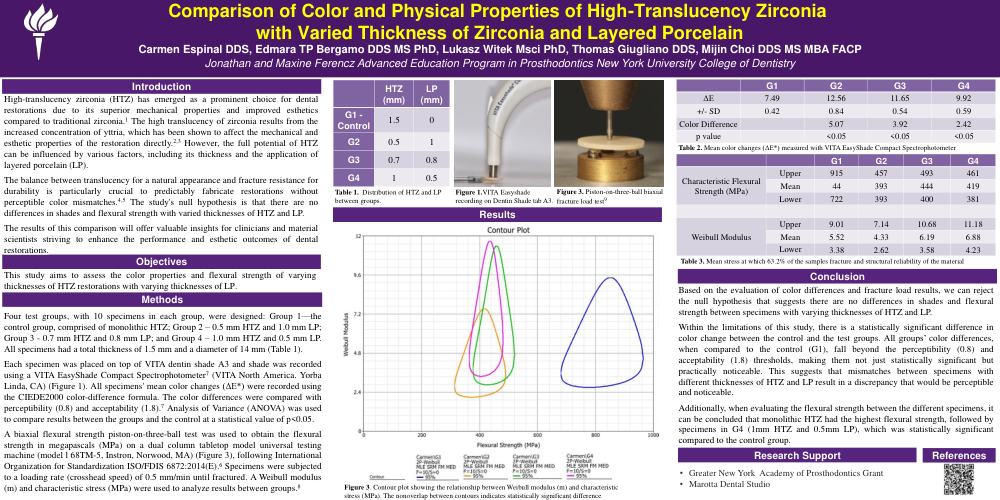
Four test groups, with 10 specimens in each group, were designed: Group 1—the control group, comprised of monolithic HTZ; Group 2 – 0.5 mm HTZ and 1.0 mm LP; Group 3 - 0.7 mm HTZ and 0.8 mm LP; and Group 4 – 1.0 mm HTZ and 0.5 mm LP. All specimens had a total thickness of 1.5 mm and a diameter of 14 mm (Table 1).
Each specimen was placed on top of VITA dentin shade A3 and shade was recorded using a VITA EasyShade Compact Spectrophotometer7 (VITA North America. Yorba Linda, CA) (Figure 1). All specimens' mean color changes (ΔE*) were recorded using the CIEDE2000 color-difference formula. The color differences were compared with perceptibility (0.8) and acceptability (1.8).7 Analysis of Variance (ANOVA) was used to compare results between the groups and the control at a statistical value of p<0.05.
A biaxial flexural strength piston-on-three-ball test was used to obtain the flexural strength in megapascals (MPa) on a dual column tabletop model universal testing machine (model l 68TM-5, Instron, Norwood, MA) (Figure 3), following International Organization for Standardization ISO/FDIS 6872:2014(E).6 Specimens were subjected to a loading rate (crosshead speed) of 0.5 mm/min until fractured. A Weibull modulus (m) and characteristic stress (MPa) were used to analyze results between groups.8
Conclusion
Based on the evaluation of color differences and fracture load results, we can reject the null hypothesis that suggests there are no differences in shades and flexural strength between specimens with varying thicknesses of HTZ and LP.
Within the limitations of this study, there is a statistically significant difference in color change between the control and the test groups. All groups’ color differences, when compared to the control (G1), fall beyond the perceptibility (0.8) and acceptability (1.8) thresholds, making them not just statistically significant but practically noticeable. This suggests that mismatches between specimens with different thicknesses of HTZ and LP result in a discrepancy that would be perceptible and noticeable.
Additionally, when evaluating the flexural strength between the different specimens, it can be concluded that monolithic HTZ had the highest flexural strength, followed by specimens in G4 (1mm HTZ and 0.5mm LP), which was statistically significant compared to the control group.