136 posters, 2 topics, 27 sessions, 339 authors, 88 institutions
ePostersLive by SciGen Technologies S.A. All rights reserved.
2024 ACP Annual Session
NOVEMBER 6-9, 2024 | MARCO ISLAND, FL JW MARRIOT

149
The Effect of Surface and Heat Treatments on Phase Composition, Crystal Size, Strain, and Topography of high-cubic zirconia Material: A pilot study
Poster Presenter
Authors
Affiliations
Part of Topic
Original Research
The Effect of Surface and Heat Treatments on Phase Composition, Crystal Size, Strain, and Topography of high-cubic zirconia Material: A pilot study
Introduction
5Y-TZP has gained popularity in esthetic dentistry for its improved optical. High-cubic zirconia lacks the transformation toughness phenomenon observed with conventional zirconia (3Y-TZP), thus, it has less flexural strength but is more resistant to low thermal degradation. There is scarce information about cubic crystal's response to external stress applied through daily conducted surface and heat treatment.
Purpose
To investigate the effect of different surface and heat treatments on the phase composition, crystal size, strain, and topography of high-cubic zirconia (5Y-TZP).
Methods
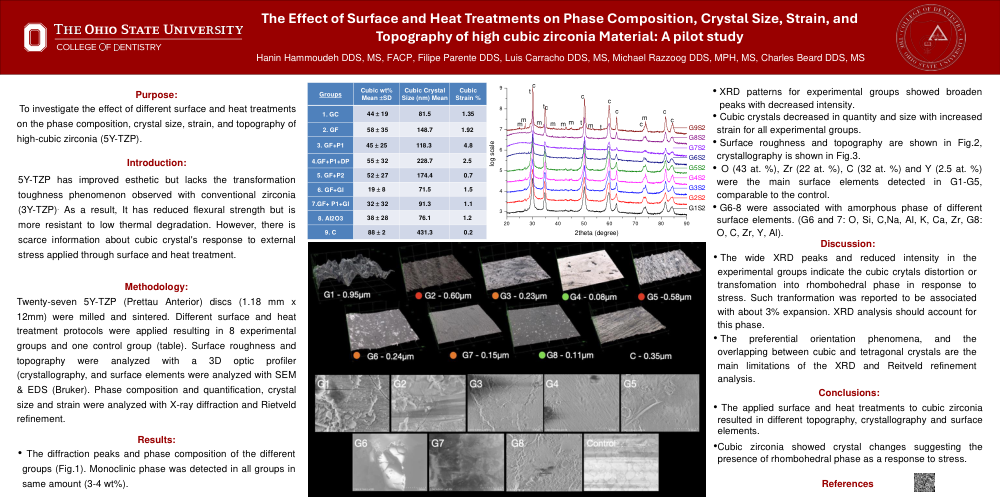
Twenty-seven discs of 1.18 mm thickness and 12mm diameter were milled in 5Y-TZP and sintered. Different surface and heat treatment protocols were applied resulting in 8 experimental groups and one control group (Table1), n=3. Surface roughness and topography were analyzed with a 3D optic profiler, crystallography and surface elements were obtained with SEM and EDS, while the phase composition and quantification, crystal size, stress and strain were analyzed with X-ray diffraction and Retvield refinement.
Results
Surface roughness and topography are shown in Fig.1.
Surface elements and crystallography are shown in Fig.2.
Fig.3 shows the diffraction peaks and phase composition of the different groups. Monoclinic phase was detected in all groups.
Cubic crystals decreased in quantity and size with increased strain for all experimental groups. XRD patterns for experimental groups showed broad peaks with decreased intensity.
Conclusion
The applied surface and heat treatments to cubic zirconia resulted in different topography and surface elements.
Cubic zirconia showed crystal changes suggesting the presence of rhombohedral phase as a response to stress.