136 posters, 2 topics, 27 sessions, 339 authors, 88 institutions
ePostersLive by SciGen Technologies S.A. All rights reserved.
2024 ACP Annual Session
NOVEMBER 6-9, 2024 | MARCO ISLAND, FL JW MARRIOT

148
Marginal fit comparison between 3D printed ceramic-filled resin and CAD/CAM milled Zirconia for maxillary anterior single crowns.
Poster Presenter
Authors
Affiliations
Part of Topic
Original Research
Marginal fit comparison between 3D printed ceramic-filled resin and CAD/CAM milled Zirconia for maxillary anterior single crowns
Nadima Khodor, BDS, Jude Itani, BDS, MS, David Donatelli, DDS, FACP, Gerald Grant, DDS,MS, FACP
objectives:
This study aims to examine the marginal gap at the mid-facial, mid-lingual, mid-mesial, and mid-distal locations of the prepared tooth for both milled and printed crowns.
hypothesis:
We hypothesize that CAD/CAM milled Zirconia maxillary crowns will have a better marginal fit at all dimensions when compared to those 3D printed.
introducation:
PFM restorations are the gold standard for their mechanical properties,¹ but face certain limitations.² ³ Ceramics, especially zirconia, have become popular in dentistry for their esthetics, biocompatibility, and superior mechanical properties.⁴
In 2023, SprintRay introduced "Ceramic Crowns," made of over 50% ceramic, offering high strength and wear resistance. Available in multiple shades, these crowns are FDA cleared and CDT compliant.
A precise marginal fit is essential for crown longevity, as discrepancies can lead to plaque buildup, inflammation, caries, and bone loss.⁵ ⁶ ⁷
materials and methods:
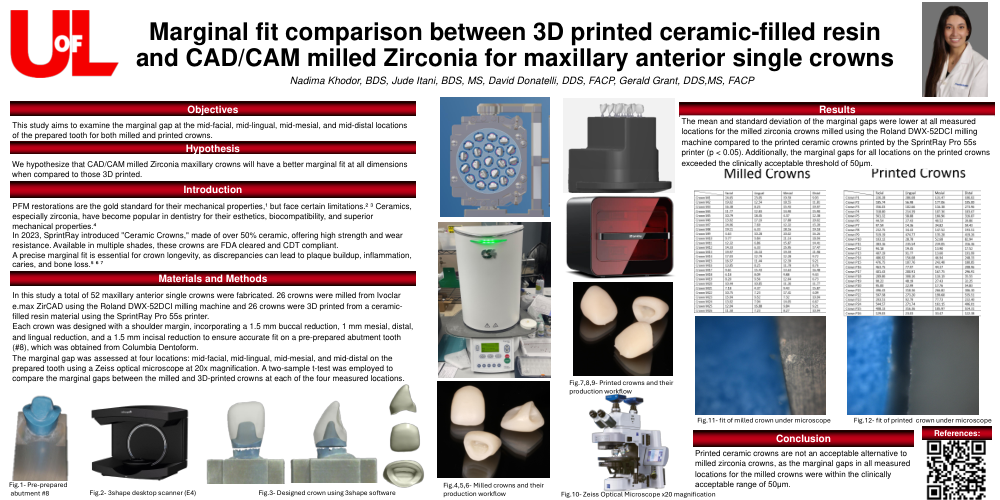
In this study a total of 52 maxillary anterior single crowns were fabricated. 26 crowns were milled from Ivoclar e.max ZirCAD using the Roland DWX-52DCI milling machine and 26 crowns were 3D printed from a ceramic-filled resin material using the SprintRay Pro 55s printer.
Each crown was designed with a shoulder margin, incorporating a 1.5 mm buccal reduction, 1 mm mesial, distal, and lingual reduction, and a 1.5 mm incisal reduction to ensure accurate fit on a pre-prepared abutment tooth (#8), which was obtained from Columbia Dentoform.
The marginal gap was assessed at four locations: mid-facial, mid-lingual, mid-mesial, and mid-distal on the prepared tooth using a Zeiss optical microscope at 20x magnification. A two-sample t-test was employed to compare the marginal gaps between the milled and 3D-printed crowns at each of the four measured locations.
results:
The mean and standard deviation of the marginal gaps were lower at all measured locations for the milled zirconia crowns milled using the Roland DWX-52DCI milling machine compared to the printed ceramic crowns printed by the SprintRay Pro 55s printer (p < 0.05). Additionally, the marginal gaps for all locations on the printed crowns exceeded the clinically acceptable threshold of 50μm.
conclusion:
Printed ceramic crowns are not an acceptable alternative to milled zirconia crowns, as the marginal gaps in all measured locations for the milled crowns were within the clinically acceptable range of 50μm.