136 posters, 2 topics, 27 sessions, 339 authors, 88 institutions
ePostersLive by SciGen Technologies S.A. All rights reserved.
2024 ACP Annual Session
NOVEMBER 6-9, 2024 | MARCO ISLAND, FL JW MARRIOT

147
Available Evidence on Polishability of Additive-Manufactured Base for Complete Dentures
Poster Presenter
Authors
Daniel Diaz, Ramtin Sadid-Zadeh, Omar Mohamed, Rashmi Radhakrishnan
Affiliations
Part of Topic
Original Research
Available Evidence on Polishability of Additive-Manufactured Base for Complete Dentures
Daniel Diaz, DDS.; Omar Alabd Mohamed, BDS, MS.; Rashmi Radhakrishnan, BDS, DMD, MS.; Ramtin Sadid-Zadeh, DDS, MS.
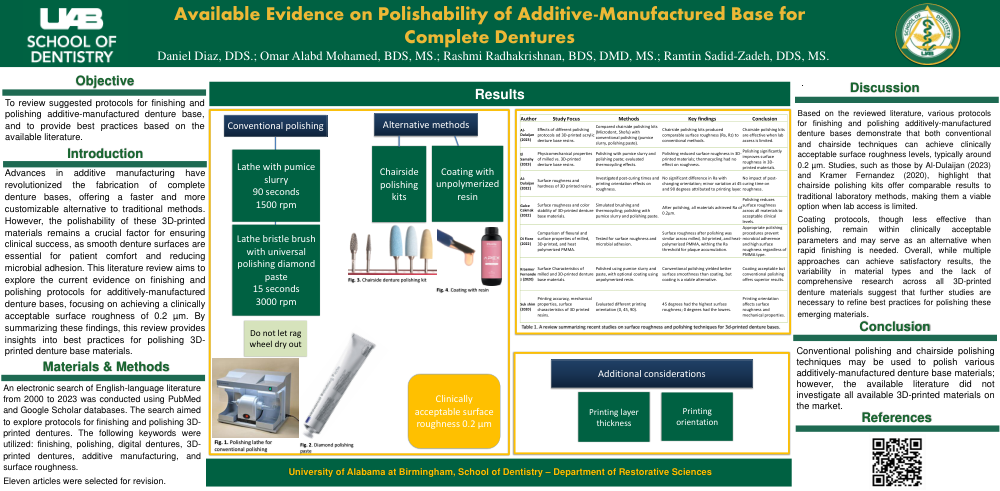
Objective: To review suggested protocols for finishing and polishing additive-manufactured denture base, and to provide best practices based on the available literature.
Introduction: Advances in additive manufacturing have revolutionized the fabrication of complete denture bases, offering a faster and more customizable alternative to traditional methods. However, the polishability of these 3D-printed materials remains a crucial factor for ensuring clinical success, as smooth denture surfaces are essential for patient comfort and reducing microbial adhesion. This literature review aims to explore the current evidence on finishing and polishing protocols for additively-manufactured denture bases, focusing on achieving a clinically acceptable surface roughness of 0.2 µm. By summarizing these findings, this review provides insights into best practices for polishing 3D-printed denture base materials.
Materials and methods: An electronic search of English-language literature from 2000 to 2023 was conducted using PubMed and Google Scholar databases. The search aimed to explore protocols for finishing and polishing 3D-printed dentures. The following keywords were utilized: finishing, polishing, digital dentures, 3D-printed dentures, additive manufacturing, and surface roughness. Eleven articles were selected for revision.
Discussion: Based on the reviewed literature, various protocols for finishing and polishing additively-manufactured denture bases demonstrate that both conventional and chairside techniques can achieve clinically acceptable surface roughness levels, typically around 0.2 µm. Studies, such as those by Al-Dulaijan (2023) and Kramer Fernandez (2020), highlight that chairside polishing kits offer comparable results to traditional laboratory methods, making them a viable option when lab access is limited. Coating protocols, though less effective than polishing, remain within clinically acceptable parameters and may serve as an alternative when rapid finishing is needed. Overall, while multiple approaches can achieve satisfactory results, the variability in material types and the lack of comprehensive research across all 3D-printed denture materials suggest that further studies are necessary to refine best practices for polishing these emerging materials.
Conclusion: Conventional polishing and chairside polishing techniques may be used to polish various additively-manufactured denture base materials; however, the available literature did not investigate all available 3D-printed materials on the market.