136 posters, 2 topics, 27 sessions, 339 authors, 88 institutions
ePostersLive by SciGen Technologies S.A. All rights reserved.
2024 ACP Annual Session
NOVEMBER 6-9, 2024 | MARCO ISLAND, FL JW MARRIOT

138
Assessing the Reproducibility of Electronic Devices Aimed at Replacing Mechanical Pantograph
Poster Presenter
Authors
Affiliations
Part of Topic
Original Research
Assessing the Reproducibility of Electronic Devices Aimed at Replacing the Mechanical Pantograph
Introduction:
Treating complex cases requires the precise capture of specific records. The conventional workflow of these types of cases includes impressions, finding a repeatable position of centric relation (CR), and recording border movement to create a diagnostic wax-up for definitive restorations. An accurate facebow to orient the maxillary cast on an articulator, and a repeatable centric jaw relation record to orient the mandibular cast with the maxillary, have been the long-used analog data acquisition in restoring occlusion. Recording the border movements of the mandibular jaw is an additional but very important important step to help build functional occlusion and decrease the number of interferences, that prevent the goal of harmony between form and function. The use of a pantograph and a fully adjustable articulator can be used to help achieve this goal. Digital dentistry allows for improved accuracy or the records and laboratory phases of fabricating restorations. Newer mandibular tracking devices that utilize a digital workflow are considered as an alternate to the mechanical means.
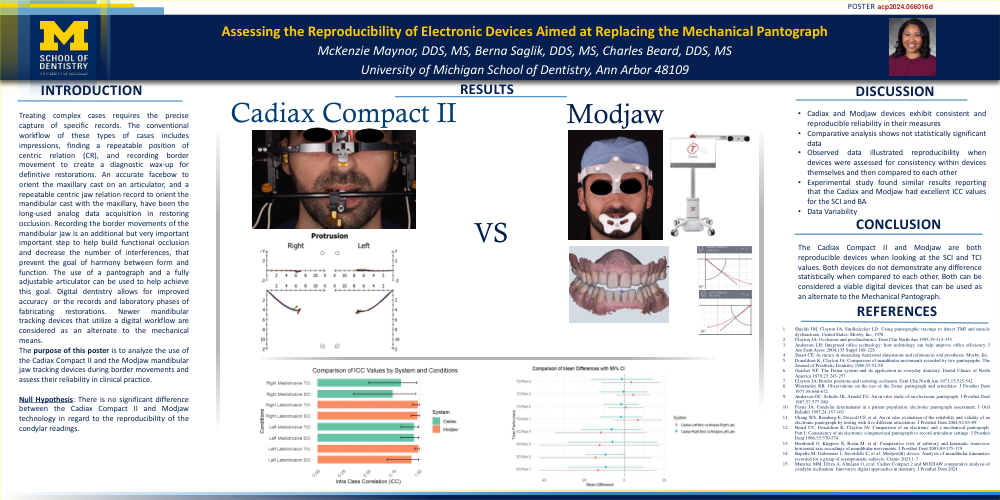
The purpose of this poster is to analyze the use of the Cadiax Compact II and the Modjaw mandibular jaw tracking devices during border movements and assess their reliability in clinical practice.
Null Hypothesis: There is no significant difference between the Cadiax Compact II and Modjaw technology in regard to the reproducibility of the condylar readings.
Discussion:
The Cadiax Compact II and Modjaw are both reproducible devices when looking at the SCI and TCI values. Both devices do not demonstrate any difference statistically when compared to each other. Both can be considered a viable digital devices that can be used as an alternate to the Mechanical Pantograph.