136 posters, 2 topics, 27 sessions, 339 authors, 88 institutions
ePostersLive by SciGen Technologies S.A. All rights reserved.
2024 ACP Annual Session
NOVEMBER 6-9, 2024 | MARCO ISLAND, FL JW MARRIOT

131
Accuracy of AI-based CAD softwares in margin detection and crown contour design
Poster Presenter
Authors
Mariam Bekkali, Leonardo Nassani, Hanin Hamoudeh, Kedith Sawangsri
Affiliations
Part of Topic
Original Research
Introduction:
As the field of prosthodontics evolves, embracing AI software stands to revolutionize how practitioners approach complex cases, ultimately leading to improved outcomes and a higher quality of life for patients. • AI technologies are emerging as powerful tools that can revolutionize traditional practices. • By harnessing the capabilities of machine learning, computer vision, and data analytics, AI offers innovative solutions for diagnosis, treatment planning, and the design of dental prosthetics. • This study aims to compare the accuracy of margin detection and crown contour design from digital impressions between two AI-based CAD softwares and one experienced dental technician.
Materials and methods:
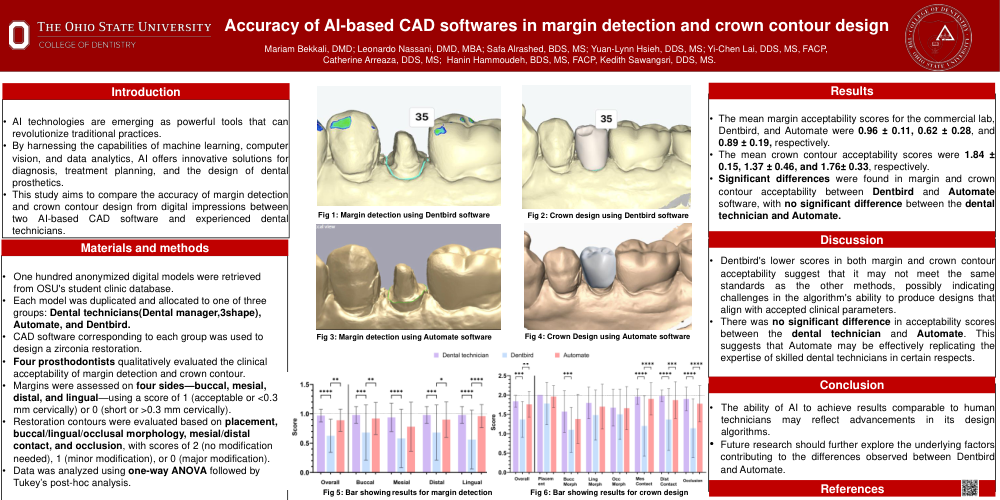
One hundred anonymized digital models were retrieved fromOSU's student clinic database. • Each model was duplicated and allocated to one of three groups: commercial lab, Automate, and Dentbird. • CAD software corresponding to each group was used to design a zirconia restoration. • Four prosthodontists qualitatively evaluated the clinical acceptability of margin detection and crown contour. • Margins were assessed on four sides—buccal, mesial, distal, and lingual—using a score of 1 (acceptable, <0.3 mm cervically) or 0 (short, >0.3 mm cervically). Restoration contours were evaluated based on placement, buccal/lingual/occlusal morphology, mesial/distal contact, and occlusion, with scores of 2 (no modification needed), 1 (minor modification), or 0 (major modification). • Data was analyzed using one-way ANOVA followed by Tukey’s post-hoc analysis.
Results:
The mean margin acceptability scores for the commercial lab, Dentbird, and Automate were 0.96 ± 0.11, 0.62 ± 0.28, and 0.89 ± 0.19, respectively. • The mean crown contour acceptability scores were 1.84 ± 0.15, 1.37 ± 0.46, and 1.76± 0.33, respectively. • Significant differences were found in margin and crown contour acceptability between Dentbird and Automate software, with no significant difference betweenthe dental technician and Automate.
Discussion:
Dentbird's lower scores in both margin and crown contour acceptability suggest that it may not meet the same standards as the other methods, possibly indicating challenges in the algorithm's ability to produce designs that align with accepted clinical parameters.
There was no significant difference in acceptability scores between the dental technician and Automate. This suggests that Automate may be effectively replicating the expertise of skilled dental technicians in certain respects.
Conclusion:
The ability of AI to achieve results comparable to human technicians may reflect advancements in its design algorithms.
Future research should further explore the underlying factors contributing to the differences observed between Dentbird and Automate.